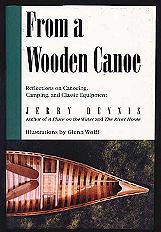
An excerpt, taken from "From a
Wooden Canoe: Reflections on
Canoeing, Camping and Clasic Equipment"
"Shuttle Cars" by Jerry Dennis
As a matter of principle I prefer automobiles that are worth
less than my canoes. I'm no financial genius, heaven knows, but it seems to
make sense to spend money on things that don't plummet in value from one
year to the next. Cars depreciate much faster than canoes. Thus it is a
shrewd business move to buy a new canoe every few years while driving
an old car into the ground. Besides, as every paddler and angler knows,
the only really good use for automobiles is to carry you and your gear to
the water, and you don't need a showroom BMW for that.
Years ago a friend of mine converted his 1964 Chevy Impala
into one of the finest shuttle cars I've ever seen. He yanked the backseat out to
make storage room for camping equipment, mounted a compass on the
dashboard, and wired a clipboard for maps to the steering wheel. He
bolted eye hooks to the bumpers for more convenient rope work, and
welded car-top carriers to the roof. Whenever the body showed rust he
slapped on a fresh coat of green house paint he had bought on sale at
Montgomery Ward. The paint was so bright that when we were still two or three
bends away on a river we could see the verdant glow of his car above the
trees.
A shuttle car is always immediately recognizable. There are
spots on the body where ropes have worn the paint away, gouges on the side
panels, a muffler held together with baling wire and fiberglass tape. The
inside is so filled with paddles, coolers, personal flotation devices, rods
and reels, sleeping bags, and tents that there is scarcely room for a
driver, let alone passengers. The tires are bald and the wheels lack hubcaps.
The entire car, inside and out, is coated with a uniform layer of good
clean dust.
I've owned many decent shuttle cars and trucks, but the best
have been station wagons, primarily because of their load capacity. My most
recent wagon was a 1980 Ford Fairmont that logged more than 160,000 miles
before its final, fatal loss of compression. When packed with care, Old Blue
could carry three canoes and six people, all the usual camping and
canoeing accessories, plus two or three spare tires and a case of
Pennzoil 10W30. She got uncommonly good mileage for a shuttle car --
twenty or so miles to the gallon -- but leaked a quart of oil every
tankful. Also, her front end shimmied at highway speed, she stalled
at intersections, and the air-conditioning and the heater both produced
about the same volume of lukewarm air. But she took my canoe and me
where we wanted to go and usually got us home at the end of the day.
You can't ask more than that from a shuttle car.
The great advantage of owning a motor vehicle worth less than
a couple thousand dollars is that it frees you to be gloriously indifferent to
the scratches and dents that appear inevitably when you drive rutted back
roads in search of rivers. Older vehicles have the further advantage
of being much easier to repair than recent models with their complex
electronic carburetors and computerized ignition systems. When you're
bucking two-tracks forty miles from the nearest highway, you
appreciate a car that can be fixed with a screwdriver, a crescent wrench, a pair of
pliers, and a roll of binding wire.
Marty's brilliant '64 Impala is a case in point. We once set
out in it for Ontario but barely got over the Mackinaw Bridge before the
oil-pressure light came on, and the engine began to buck and cough.
We turned from the highway to a secondary road and pulled over to make
repairs. But before we could even lift the hood we noticed a bridge a
hundred yards ahead of us and strolled over to take a look. It
crossed a river, a beguiling river, with tea-tinted water flowing over boulders
and trout rising methodically in midstream. We knew we could fix the car
-- it needed a long drink of oil and some screwdriver adjustments of its
points and distributor -- but it would take an hour, and already the
day was growing short. So we unloaded our gear and set off down the
river. It was the right decision. We had a fine weekend exploring new
territory. The fishing was good and the river interesting, and we
never saw another soul. When we ran out of time on Sunday we stopped at a
bridge, flipped a coin, and Marty hitchhiked back to the car. He
started the engine, made some minor adjustments, and the car got us home
without incident.
All you really need from a car is dependability. At the end
of a long day on the water, when you're tired, chilled, and hungry and the sun
is gone and the evening turning cool, the sweetest moment comes when
you've put away your gear, secured your canoe to the carriers, and have
settled finally into the seat of your car. It's dry and comfortable there and
smells like home. You pump the accelerator a few times, take a deep
breath, and turn the key in the ignition. The engine grinds, coughs,
sputters, and catches. It hums, it clatters, it throws a fine and
reassuring spray of lubricant around the engine compartment. You back
around, shift into forward, and lurch down the trail toward the
highway. No cowboy ever had a mount so faithful. "Home, Hoss,"
you say, and she obeys, and all's well with the world. ~ Jerry Dennis
(Jerry Dennis lives in Traverse City, MI and is the author of seven
books, including THE RIVER HOME, A PLACE ON THE
WATER, and CANOEING MICHIGAN RIVERS. This essay
is excerpted from his latest book, FROM A WOODEN CANOE:
REFLECTIONS ON CANOEING, CAMPING, AND CLASSIC
EQUIPMENT, published by Thomas Dunne Books/St. Martin's Press.
Hardcover, 204 pgs., $21.95. Illustratred by Glenn Wolff.
You Might Be A Fly Fisherman If...|
River Home, Part 1
River Home, Part 2 |
Creative Counting
Best By Test|
E Pluribus Unum
All About Entomology|
Fly Tying Types
Brook Trout
Going crazy; the World's Smartest Fishing Dog (#1)
Crazy Man|
My Jacket |
"OYES OYES" |
Fresh Look at Catch & Release
A Fly Fisher's Ten Commandments
Waders
Local Fishing
"How To Swipe A Trout"
Chicken Fish'n
Bryce Crowing on Chicken Fishing
Darnit, Santa and Rudolph
When Bad Rods Happen to Good People
Flyfishing for Squirrels
Sparing the Rod, Part 1
Sparing the Rod, Part 2
Sparing the Rod, conclusion
Crime Doesn't Pay Whom?
Answering Technical Questions
Here Rover
Getting the Boot
|