Hunting Hunters in the Yoop
By Joe Heywood
I rode patrols with conservation officers in Michigan's western
Upper Peninsula, November 12-18, 2001. Having already written
a novel about a conservation officer, [The Ice Hunter] I learned
and saw more than I could imagine. What follows is fact - and
the fuel for future fiction.
It is the afternoon before the firearms deer season is to begin and
we are bumping along a Class VI road (a road in name only) near
Hemlock Rapids on the Paint River in Michigan's very rugged and
hilly western Yoop (Upper Peninsula). Michigan's wolf guru Jim
Hammill has gotten a radio call from one of his pilots reporting
a mortality signal from a radio-collared wolf. A mortality signal
sounds if a wolf is still for four hours. We are asked to help
locate the animal.
"Wolves," Mike Webster says with a grimace. With deer season in
the face, conservation officers have their minds set on deer hunters
and their likely antics. Tracking a wolf can take a lot of time and
remove officers from preparations for the two-week dance which is
about to begin. Time is a major issue for an officer and each of
them tries to use their time judiciously, but reality often intervenes
to change the plan.
Just yesterday CO Steve Burton and I went to find a man who had
brought a bobcat into the District 3 Office in Crystal Falls to
be sealed as an animal taken under a fur-harvesting license (meaning
it was trapped). An hour later the biologist mentioned to someone
in Law Enforcement that the animal had a large hole in its side
and maybe everything wasn't copasetic.
We found two old men at a small frame house in the old mining
town of Gaastra. One of the men uses a cane to pull the truck
door closed behind him. Steve asks about the bobcat, which
belongs to the brother of one of the men.
"Already gone taxidermist," he says in Yooperese.
Steve presses him. "You're sure it's gone?"
"Well, we look da garage, eh?" the old fellow says, leading the
way to the garage and opening the door.
There lies the cat with the gaping hole in its side. Steve says,
"That looks like a gunshot wound."
"Nah, the man says. "She was a bow, eh?"
The man's brother had shot the bobcat while deer hunting, then
went to get a post facto fur harvester's license, hoping to pass
it off. This almost worked. Steve confiscates the carcass and
tells the brother there is a problem with the tagging and for
his brother to call him. Instead, the brother calls CO Dave
Painter that night and confesses to him. Dave passes word to
Steve and tells him the hunter is worried about not being able
to keep the bobcat. It takes three days before the spooked
cat-killer will come in to face Steve. The poacher won't get
the animal back. You don't get to keep a stolen car either.
After the bobcat deal Steve and I went to court in Iron Mountain
where he testified at a hearing to condemn a weapon. He had found
a loaded and cocked .45-caliber in a glove compartment last summer.
The judge forces him to testify before the deputy prosecutor. The
condemnation is uncontested and it seems to me this could have been
handled without the court proceeding, but it is instructive to
watch and to listen to Steve and the prosecutor prepare for the
brief hearing. This was to be Steve's day off. So much for that
notion. We are two days from deer season and all officers are
already mentally into the tasks and challenges that loom ahead.
So Mike isn't happy to be chasing a wolf today because it takes
away from preparations for deer season. There is also another
factor. When cattle or sheep get killed, or hunting dogs get
chomped by wolves, it's often the COs who get the complaints
and bear the brunt of criticism. Having spent three decades in
corporate PR, I know what it's like to serve in an organization's
fecal shield.
But we have a job to do and head out. The road is bad and there
has been logging in the area, which has left it crisscrossed with
all a varicosity of trails that lead nowhere. We have a section
number for a location, which we have marked in a section map book;
we have to stop, get out and check little orange tags on trees to
determine where we are. My old Air Force navigation skills are not
a detriment to the effort.
Linda, the area forester, and Monica, Jim Hamill's wolf technician,
are thirty minutes behind us in another vehicle. They have a GPS
and a portable antenna. Eventually we all rendevous. Monica turns
on the antenna, which is shaped like an H and makes clicking
sounds. She holds it over her head and swivels herself in a
three-sixty.
"Down there," she says, pointing.
"Cedar swamp," Mike says with a grunt. "Let's hope we don't go swimming."
He strips off his gray uniform blouse and Kevlar vest and heads into
the swamp in his T-shirt.
Monica walks with the antenna over her head and we all listen to help
pinpoint where the sound is strongest. The river is about a half-mile
away and we know that the pilot got the signal somewhere in this section,
so the search could be long or short, but we get lucky and find the
animal within two hundred yards of where we are parked. Mike is the
one to find the animal, a classically colored gray wolf laying on
its right side with a red plastic tag in its left ear. Wolf No.159.
It looks like it stretched out to take a nap. The ground is covered
with lush green moss. I begin taking photographs. It is a male, maybe
seventy pounds and looks healthy. No sign of mange, a common problem.
Mike and Linda drag the animal out to the trucks. The stench when
they lift it tells us it has been dead for a while, maybe from the
day before. Anything that dies in this weather will rot and stink
fast. Hunters will need to get their deer to processors, or risk
the meat spoiling.
The dead wolf goes with Monica and Linda back to the District Office
in Crystal Falls, where it will be x-rayed before it is sent to the
Rose Lake Lab near Lansing for a full necropsy. The x-ray can show
any traces of metal from a bullet or arrow.
This one looks like a natural death, but within three days hunters
will shoot three more wolves. This happens every deer season. In
all of this fall's shootings, the hunters turn themselves in.
Usually wolves are shot every fall and nobody takes responsibility.
Not all the shooters get away with it. Detective Steve Johnson of
Iron River tracked a wolf-killer for a year, but finally got
him - in Wisconsin.
*****
That same night I am standing in the bed of a DNR patrol truck. It
is the night before the firearms deer season and we have backed the
truck up a two-track into a copse of popples. From our position we
can see vehicles approaching on the hardtop a half-mile away. I
am with Sergeant Mike Webster and Officer Dave Painter. Mike lives
in Crystal Falls and supervises COs in Iron, Dickinson and Gogebic
Counties. Mike grew up BTB (below the bridge, meaning lower Michigan,
a huge distinction up here). Dave is originally from Clinton County
(also BTB) and now lives in Crystal Falls and handles Iron County.
For two hours this afternoon the two officers had a running discussion
about finding an appropriate field to sit on tonight in anticipation
of jack-lighters. COs are highly motivated and because there are so
few of them with so much territory to cover, they find themselves
torn between where they are and where they might be. I often feel
the same conflict when I am trout fishing.
The night air is cool, but this is November and the air should be frigid.
Instead, it is almost soft, like a spring night, a harbinger of the
unseasonably warm deer season to follow.
We sit in total silence for three hours but see little and hear no
wayward shots. A couple of vehicles look like they might be thinking
about head-lighting, but no spotlights come on and they pass by us
into the darkness. We know there are deer in the potato field in
front of us because we counted thirty or so with a quick glance as
Dave backed the truck into position.
The western U.P. is in on central time - an hour behind the rest of
the state -- and we have darkness by 4:30. We figure that our chances
of picking off night-shooters might be better after the bars close,
but we also have to think about the next morning, when BOB will be
afield in force. B.O.B is the Blaze Orange Brigade. In Michigan this
season about 750,000 hunters will be toting their shotguns and rifles
around the woods. Usually there are more than one million hunters
out during gun season. Last winter was a tough one up north and
the deer herd estimates are down for the Yoop. And the weather
isn't conducive to hunting this year, and these two factors may
contribute to fewer hunters out and about. Or there could have
been solar flares.
We are tucked into a two-track with barren potato fields on either
side of us and another one across the narrow ribbon of blacktop.
In the swamp beyond the field across the road we hear a truck motor
grinding and roaring. It sounds like it is trying to get down a
muddy road and not doing well and this prompts some second-guessing
about our positioning.
"Maybe we should be down on the other side of that field," Dave says
as the unseen truck continues to whine and sputter and struggle.
Mike shrugs and says, "It really sucks to be that guy."
*****
Opening morning we are on foot, humping up a steep ridge to some
illegal blinds that the area forester told Dave about. The foresters
are responsible for surveying huge tracts of land and often see things
that they pass on to the law enforcement personnel.
Mike and Dave fly up the steep ridge like gazelles and I lag behind.
At one point Mike looks back and says, "We're not going to have a
heart attack are we?"
I'm too winded to even make a wisecrack. I shake my head and
keep climbing and puffing.
We find a twenty-something man from Wisconsin sitting in an illegal
blind. He has been placed there by his grandfather and is under the
impression he is on private land, when it is actually public. He
also has shot a five-point buck, which Mike goes down to check.
Mike will retire this coming spring with twenty five years of service
and he has the scars of a quarter century, including a bad back from
several vehicle accidents and mishaps. You'd never know it to watch
him move, but he constantly berates the younger officers for their
driving. One afternoon with Steve Burton, Mike shouted for him to
stop and back up. Steve asked why.
"Because you missed a rock back there and since you've hit all the
rest of them, I didn't want you to miss that one, Officer!"
The deer is properly tagged, but Dave tickets the young man for
the illegal blind and tells him, that if his grandfather is a
standup guy, he ought to pay the ticket for him because he put
him in the position and ought to know the law. Dave reminds him
he will also have to remove the blind, even though it belongs
to his grandfather. "The law says the user is responsible," Dave
informs him. The cheesehead shrugs.
*****
We are on the road and about to pass a vehicle rolling slowly toward
us. Dave says excitedly to Mike, "Stop!" Dave immediately bails out,
cuts behind our truck and across the front of the other vehicle.
Mike gets out more deliberately. A slovenly man and a passenger
get out of the other truck. The driver grins insipidly at Mike.
"You guys have any luck this morning?" Mike asks.
"Nah, too hot."
Mike checks their cased rifles. They are unloaded.
Dave comes around the back of the truck and the driver gets a
goofy look and says sarcastically, "If it ain't Deputy Doolittle."
Dave maintains his cool, but it is clear there is some history here.
Back in the truck he's agitated and tells Mike he's busted the
guy several times before, that he's up from Chicago and his camp
is a mess. Dave says. "Bums."
"Do you need a hug, Officer Painter?" Mike asks with a laugh.
"The guy's a jerk," Dave says, shaking his head.
*****
Two hours later we are cruising a narrow gravel road when a
pickup comes skidding around a curve too fast and Mike is forced
to put our right side almost into the ditch. The driver may be
intoxicated.
"Get 'im!" Dave yelps. We make a fast one-eighty and Mike pursues
and we make the stop. Two guys get out. They are also from Chicago
and the driver denies he was going too fast. They say they aren't
hunting. Mike and Dave check licenses and cased rifles. The driver
pulls out a wad of money as thick as the slide on a shotgun. Mike
calls in on the radio to check outstanding warrants. Nothing. The
two men tell Dave where they are staying and that they were out
gambling last night and are headed back to the casino again tonight.
They say it's too hot to hunt. Mike lets the driver off with a
warning.
"Did you see that wad?" I ask Dave, who laughs.
"He pulled out another one while you guys were on the radio!"
*****
We find a camp along a nearby road. There is an uncased rifle across
the seat of a four-wheeler.
"Uh-oh," Mike says. "What we have here is a gonna-happen moment."
We drive down the road and wait. Eventually a four-wheeler comes
down the road, but cuts to our left before it gets to where we are
waiting. Mike quickly follows the tracks on the hard dirt and we
eventually find an elderly woman wearing orange and red, sitting
on a log five yards off the tote road.
"Did you come in on the four-wheeler?" Dave calls over to her.
"Yah, with my husband."
We drive further on and find the four-wheeler. The driver is frail
and elderly. He is taking his loaded Model 90 Winchester off the
handlebars. No helmets in sight.
Mike talks to him. He hunted this area with his brother fifty years
ago and wanted to come back and see it again.
Dave checks his license and sees that his age is late eighty-something.
He asks the man what he ascribes his long life to.
"Good whiskey and a hot woman," the old guy says, grinning.
Mike lets him off with a gentle warning. "We can't bust an old
geezer," Mike says when we are back in the truck. Mike lets
over-seventies from his church hunt his property in Crystal Falls.
The sergeant sometimes comes across as gruff, but he has a soft
spot for people, and genuine empathy. In fact empathy seems to
be a trait all officers share. In a job that requires them to
make judgments continuously, they are notably non-judgmental.
I also see no evidence of professional paranoia. They accept
the world as it is and do their jobs the best they can. This
is fascinating insight.
"Slow day," Dave says. "With this warm weather hunters are staying
put in their blinds. When the weather's cold they're usually
road-hunting by 10 a.m."
Later that day Mike will tell someone that we are experiencing a
"widespread outbreak of legality."
It's in the low sixties and it is November 15.
"Good whiskey and a hot woman?" Mike says.
All three of us laugh.
*****
On another road we find a young man hoofing down the shoulder with
his rifle slung. We stop and chat. He's a Marine, home on leave,
hunting with his father.
We find the father further on. He is sitting in a lawn chair by
the back of his truck, his arm hooked to a portable dialysis unit.
He says he's seen no deer, "but it's nice to be out."
Dave and Mike move his chair back so he's not in danger of being
hit by passing vehicles and wish him good luck.
"That was something," Dave says, his voice starting to break up.
"Hooked up to that thing and still hunting." Dave has young sons
and is teaching them to hunt and fish. I think he has projected
himself into the future and been moved by what we saw.
*****
Late that afternoon we are far away in another part of the county,
checking camps. Mike and Dave know a camp where there is sign of
a lot of recent four-wheeler activity and damage.
Mike says, "Find four-wheelers, find trouble." Most COs learn
to loathe four-wheelers, jet-skis, snowmobiles and dirtbikes.
The first camp we look at has six relatively new pickup trucks,
two expensive RVs and two large trailers for four-wheelers. There
is also a smaller and older camper trailer. A few beer cans are
on the ground, but the camp is clean by hunting camp standards.
There are two bucks hung on the camp pole, a nine-point and a
spikehorn. Nobody home. Mike and Dave like the look of the camp.
We withdraw with a plan of coming back at dark to intercept hunters
returning from the field.
"This will be a good one," Mike says. The statement is prophetic.
Meanwhile we motor to another camp we saw along the way. It is
a new camp and Dave is curious. In the western U.P. hunting
groups tend to camp on the same spots on public land year in
and year out, some groups for decades at the same place. COs
get to know the camps and their inhabitants. This is a new one.
There are several vehicles and two new large wall tents from
Cabellas. The tents are the color of eggshells.
We coast the truck into camp and quietly get out, not latching
our doors. Dave circles the camp in the woods looking for gut
piles. Mike and I walk through the camp, looking in vehicles.
By one of the tents, Mike waves a hand to get my attention.
The end flaps have been folded up and the end of the tent is
wide open. Two people are asleep on cots inside. We continue
the walk-around. Dave finds some blue jay and grouse feathers
in the woods, but nothing else. The sleepers never wake up,
never even know we are there.
"I'll come back later," Dave says.
As we drive back to the first camp Mike is on the radio. Margie,
the District 3 dispatcher has called to ask if we have had
contact with Steve Burton.
"Not since early this morning," Mike reports.
"The computer shows his truck hasn't moved all day," Margie says.
All DNR vehicles are equipped with the Automatic Vehicle
Locator -- or AVL-- which is tied into the Global Positioning
System and enables an officer's truck to be located at all
times. We can look at the rolling map in our vehicle computer
and see each other, and so can the district offices and
Lansing -- which COs call Station 20. Margie has asked
Officer Dan Helms to do a drive-by. Dan and Steve share
Dickinson County and often work together.
I tell Mike that Steve told me two days ago that he intended
to patrol by four-wheeler on opening day.
By dark we are back in the first camp. Around 4 pm we hear a
single shot.
Mike gets another radio call from Margie. Danny Helms has found
Steve's truck but there is no sign of Steve. Mike asks Margie
to ask Danny to remain in the area and for her to alert Tom
Courchaine, the district's lieutenant who is working with
officers in Delta County today.
"Problem?" I ask.
"Burton's aggressive," Mike says. "He won't back down from anybody."
His tone is something between admiration and concern. Because
COs spend most of their time alone, it's dangerous work. The
outwardly gruff sergeant is obviously concerned. With the
lieutenant in a distant county, Mike is the ranking officer
in the district. He tells Margie to "give him a bump on the
radio," as soon as she hears anything more.
Dave asks, "You want to move over to Dickinson County?" That's
where Steve's truck is.
"Not yet," Mike says, silently weighing factors. We have a brief
discussion about what it will take to mount a night search, how
we will go about it, who we will need, and how to contact them.
Then we turn our attention back to the business at hand.
Twenty minutes after the solo gunshot we see the lights of
a four-wheeler jiggling and bouncing toward camp. We shine
our Maglites to stop them.
There is a heavyset middle age man and a boy of twelve on the back.
No helmets, riding double, both of them with loaded rifles.
Safety first. The guns get unloaded.
Dave asks about the two deer on the buck pole. Who do they belong to?
"The nine-point belongs to the guy in the camper," the man says.
"The spikehorn is my dad's.
"Where's your dad, still out hunting?" Dave asks.
"No, he went back to Detroit."
Dave arches an eyebrow in my direction. "Your dad drove ten hours
to Iron County, shot a buck and drove home this morning?"
"Yeah, he had things to do."
"Grandpa had to leave," the boy says, chiming in.
Dave asks for the grandfather's phone number.
When he starts to walk back to the truck the man says, "Wait wait,
that's my number. I always get them confused."
Dave gets a second number, which he calls into Station 20 and
asks them to call and ask if the man has been hunting in the
UP today and if so where and if so did he have any luck and
if so, what?
Meanwhile, Dave checks licenses and talks to the man and boy.
No helmets, riding double, loaded guns on a vehicle and loaded
guns after dark. They already have four strikes against them.
While Dave talks to the man and his son, Mike is on the radio
again with Margie, checking on Steve Burton. He asks her to
hang in until we know what's going on with Steve.
Lansing calls back to report that the man in Detroit says he's
never hunted and that his son asked him to buy a license so
he could use it.
Dave confronts the man, who tries to stare at his feet over a
beer belly and begins to hem and haw. He tells Dave his father
has Alzheimers and asked him to get a deer for him.
Dave ignores the obvious bullshit. "Who shot the spike?" he asks.
"I did," the man says and then he begins to apologize.
Dave tells him an illegal deer here is $1500 but he is not going
to zap him with that. Instead, he walks the man over to the buck,
has him remove the illegal tag and replace it with his own.
"You're done hunting," Dave tells him. With the son out of earshot,
Dave pointedly and firmly tells the man he's disgusted that he
has a twelve-year-old lying for him. The man stares at his boots.
Dave also writes a no-helmet ticket.
"How many other four-wheelers? Mike asks.
"Four," the man says.
"Five more," the boy says, correcting his father.
"Which is it, four or five?" Mike asks.
"Six counting us," the man says.
I say, "I heard a shot."
The man quickly says, "That was me. I took a neck shot and missed
a doe." I don't ask if he has a doe permit. I have no official
capacity and am strictly riding along as an observer, but I let
Dave and Mike know what I've heard.
Over the course of my patrols I serve as a quasi-Voluntary
Conservation Officer or VCO. VCOs are trained and many have
related jobs either in the DNR or other law enforcement or
government agencies. I am simply arms and legs and eyes with
a writer's feeble brain, which is not an asset except that I
have some interviewing skills, and the ability to listen and
observe. Before taking off, I ask each officer I ride with what
they want me to do and they tell me how to play each situation
and I follow orders. I am here to help and gather information,
not to hinder. An officer's most important tool is his brain,
but two people are more of a deterrent to escalating trouble
than one. Especially in the dark.
When the other five vehicles return, the first four have two
hunters on each, no helmets and all of them with loaded weapons.
The last vehicle has a lone rider with a helmet, but his rifle
is loaded. We take the firearms and Dave unloads them while I
hold the light so he can see. Then he collects the cartridges
and clips and writes the tickets using the truck seat as a desk.
Meanwhile, Mike is on the radio again, checking on Steve Burton's
status.
The first man is telling other young hunters coming in that he
screwed up and that they have to follow the rules, but I hear
the first man's son tell the other boys in hushed tones that
he took the shot at a doe at dark and missed. His old man
lied about this too. Probably trying to protect the son,
but from what isn't clear to me.
One camp, a myriad of infractions and nine tickets. There could
have been more written.
A little after 5 p.m. we hear Steve Burton check in on the radio.
Mike is visibly relieved. This is to be Mike's final deer season
in uniform, these are "his boys" and he doesn't' want to lose
anyone. His pride in his boys and the job are palpable. He
strikes me as the prototypical warrior leader, not an administrator.
Back on the main road it is pitch black and a four-wheeler comes
hurtling down the shoulder toward us. It is flying. Mike turns
around and we catch-up. The driver is a fifteen-year-old boy
and he has on his helmet, but he also has a loaded rifle in a
case across the handlebars of the vehicle. He says he's headed
for his parents' camp. We unload the rifle and follow him. The
father comes out on the deck of the new cedar log cabin and
Dave explains the situation and gives the father a ticket for
not supervising, explaining four-wheeler and hunting rules.
The boy was driving down a federal highway that is closed to
snowmobiles and four-wheelers. The boy swears he wasn't hunting.
He just drove to a friend's camp to see a buck that was shot
down there. He says he didn't know the rifle was loaded. Dave
writes the appropriate citation for the father, who makes no
comment and shows no emotion.
It was too hot for the deer to be moving today, but we bipeds covered
more than 200 miles and walked another two or three during our
twelve-hour patrol.
On the way back to Crystal Falls Mike calls home and learns that
J.D., his father-in-law, shot a three-point this morning from
the blind Mike built for him on the side of Mt. Webster. Mike
shakes his head. Before meeting Dave and me early this morning,
Mike fetched J.D.'s lunch up to the cliff-side blind because his
father-in-law had forgotten it. His last words of the morning had
been, "No spikes or forks right, J.D.?" and his father-in-law
said, "Right."
Mike's wife, Susie, is a Michigan State Police sergeant in Wakefield
and she has already taken a four-wheeler out and fetched her dad's
deer back to their house.
"Three-point," Mike says shaking his head. Ironically, Mike
is fairly new to hunting and is ambivalent about getting a deer.
By contrast, Dave and Steve are lifelong hunters and outdoorsmen.
Later in the season Mike will hunt from his father-in-law's blind
and spend two days reading one of my novels.
"Did you see any deer?" I asked him a couple of weeks later.
"Nope. I was reading."
"You'd better be nice to your father-in-law," Dave tells Mike.
"I know my job," Mike says, grinning.
Dave also calls home to check on his wife who has gotten a buck
two consecutive years, but she has seen only does today. "Too
warm," she says. "The deer weren't moving." ~ Joe Heywood
To be continued. . .
About Joseph:
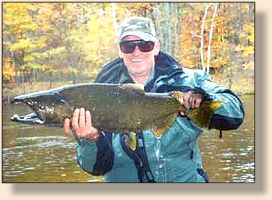 "Born in Rhinebeck New York, grew up in a USAF
family, living all over U.S. and in Italy as well. First year of high school
in Norman, Oklahoma and final three in Rudyard, Michigan in the eastern Upper
Peninsula. I graduated from Michigan State University in 1965 with BA in
journalism. There I played lacrosse on the university club team and was one of
the tri-captains in my senior year. After five years in the AF where I was a
navigator in a KC-135 tanker. Vietnam vet. After the AF I joined The Upjohn
Company in Kalamazoo in 1970; I retired in 1999 as Vice President of
Worldwide Public Relations. I have fished in Montana, Wisconsin, Minnesota,
Idaho, Colorado and Wyoming, but in none of the hallowed places in those
states. Most of my trouting has been confined to Michigan, where there is
ample opportunity and plenty of stubborn and wily fish. I wrote and published
three novels while working in the corporate world and now write fiction full
time. My fifth novel was published earlier this year by Lyons Press and my
next novel will also be published by Lyons sometime next spring. I am not a
great fisherman, but I continue to learn, which makes it a wonderful passion.
My other passion is ice hockey, namely the Detroit Red Wings."
"Born in Rhinebeck New York, grew up in a USAF
family, living all over U.S. and in Italy as well. First year of high school
in Norman, Oklahoma and final three in Rudyard, Michigan in the eastern Upper
Peninsula. I graduated from Michigan State University in 1965 with BA in
journalism. There I played lacrosse on the university club team and was one of
the tri-captains in my senior year. After five years in the AF where I was a
navigator in a KC-135 tanker. Vietnam vet. After the AF I joined The Upjohn
Company in Kalamazoo in 1970; I retired in 1999 as Vice President of
Worldwide Public Relations. I have fished in Montana, Wisconsin, Minnesota,
Idaho, Colorado and Wyoming, but in none of the hallowed places in those
states. Most of my trouting has been confined to Michigan, where there is
ample opportunity and plenty of stubborn and wily fish. I wrote and published
three novels while working in the corporate world and now write fiction full
time. My fifth novel was published earlier this year by Lyons Press and my
next novel will also be published by Lyons sometime next spring. I am not a
great fisherman, but I continue to learn, which makes it a wonderful passion.
My other passion is ice hockey, namely the Detroit Red Wings."
[His latest novel is The Ice Hunter.]
He lives in Portage, Michigan, and claims the Pere Marquette as
his 'home water.' You may find him in the Chat Room as 'Joe' or 'Joe H'.
Lighter Side Archive
|