
Deschutes River, WA
By Ron Eagle Elk (REE), WA
If you drop the name Deschutes around a bunch of
flyfishers, especially here in the Pacific Northwest,
everyone's eyes glaze over and their thoughts turn to
that magnificent river in Oregon teeming with trout
and steelhead.
Tucked away in the foothills of the Cascade Mountains
of Washington there lies another Deschutes River,
lovingly refered to as the Little D by those who work
it's waters for resident cutthroat, sea run cutthroat,
salmon, and the occasional steelhead. Unlike it's namesake
to the south, this is not a large river by any stretch
of the imagination. At it's widest point, maybe 50 feet
across, and in most places much less.
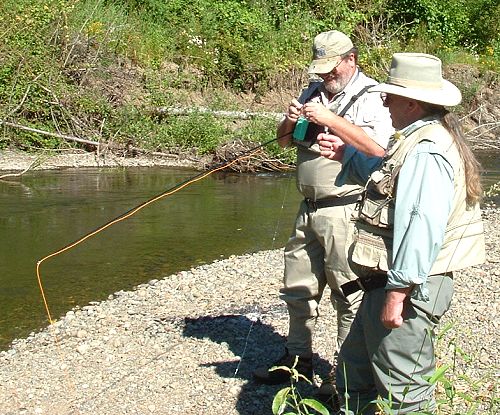
REE and Frank Bryant (Chota) discussing fly choices on the little D
The river meanders down from the hills, across farm lands,
cascades over falls, sweeps under overhanging fir, cedar,
hemlock, and broadleaf maple, past city parks and through
a municipal golf course, to finally empty into Capitol Lake
and Puget Sound. The Little D provides trout with year round
cover from the sun, eagles, ospreys and otters. It's tight
confines at some of the best "Honey Holes" exasperate the
fly anglers, where there is no backcast room, and even less
overhead room for a 9 foot rod. This is the perfect river
for the short, light lined rods we all have tucked away in
the closet just in case we find the perfect small stream.
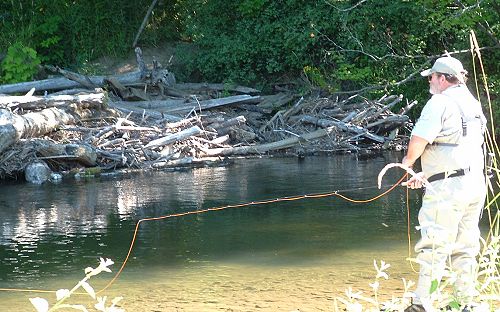
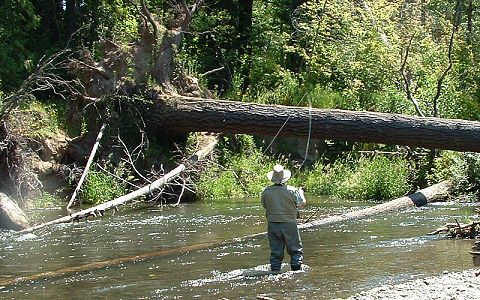
Frank Bryant working a dry fly along a log jam
In spite of the private property that lines the banks of
the river, it is very accessable to the fly anglers. Many
bridges cross the river allowing wading access, and several
parks operated by the city of Olympia and Thurston County
flank both sides of the river granting access and also
free parking.
After fishing the Little D for several years, there is one
aspect of the river that I, personally, both love and loathe.
It's almost impossible to get this little river wired. This
is a wild river. During the summer the water runs low, clear
and cold, usually from April or May well into October and
often November. Once the winter rains hit though, it becomes
a raging torrent of brown, fast moving water, uprooting the
trees that line the banks and moving rocks as large as
watermelons around in the stream bed. A favorite deep hole
one summer will be a shallow riffle the next. A beautiful
spot for casting long lines and small flies one year will
become a log jam several hundred yards long the next. Like
all wild rivers, it is ever changing, presenting new challenges
from season to season, sometimes week to week. If you can't
read the water, this river will be the one to put the skunk
on you.
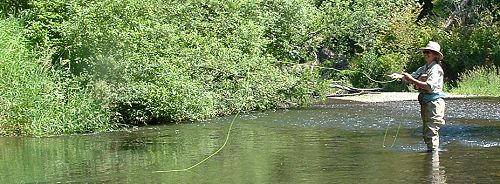
Vicky Eagle Elk on the Little D working a tail out
The resident cutts in the Little D aren't huge, a really nice
fish being 12 inches with some going to 14, but rare. However
when the leaves start changing to their fall colors the salmon
start making their way from Puget Sound, up the fish ladder
at Tumwater Falls, and deep into their natal river, the lovely
Little D. As the Salmon begin their mating dance in the stream
the Sea Run Cutthroat are close on their heels (or fins, as
the case may be). These silver bullets, fresh from the salt
usually run 12 to 18 inches and are full of fight. They are
also there to gorge on the Salmon roe and do their own mating
dance, usually further upstream. When they are fresh, they are
a bright silver, with the characteristic orange slash under
their throats. The longer they remain in the fresh water, the
more they color up to the more recognized colors of the
cutthroat. No matter what stage they are in, they are a
wonderful fish. About the same time of year a small run
of steelhead make their presence known. When casting a
three or four weight, feeling the head shake of a steelhead,
fresh from the saltwater, will definitely get your heart
rate up.
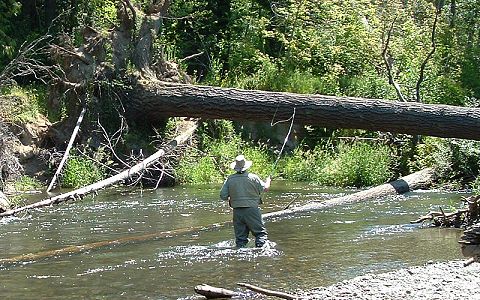
Ron Eagle Elk Casting among the logs
Fly selections for the Little D are pretty basic. There is
usually a BWO hatch around 1:00 in the afternoon on overcast
days year-round. All you need to do is match the size. Love
the BWO's, they hatch at a decent hour. In the early warm
days of spring a small black stone fly works well when the
skwallas are crawling across the water. From Mother's Day
till late October there is usually a Caddis hatch on some
kind coming off. The fiesty resident cutts have also been
known to fall for red or yellow humpys, Wulffs of many
colors and of course the Adams. When the Sea Runs are in
the river egg patterns work well, as do Chili Peppers and
Cutt Baits (both in the FAOL archives), also reverse spyders
in black, yellow and red. During the really hot days of
summer when the water is running low and clear there is
also the predominant Bikini hatch. During that time of
year it's best to fish early in the morning and late in
the evening. Midday is only good for ogling.
Fish on! Ron Eagle Elk (Self explanatory)
The seasons for the Little D vary, depending on what part
of the river your fishing. From the mouth of the river,
where it empties into Capitol Lake in Olympia, to the
top of Tumwater Falls it is closed water to protect the
migrating salmon. From Tumwater Falls through the city
of Tumwater the river is a catch and keep fishery, though
most folks practice catch and release. This section of
the river is open from June 1st to March 31st for trout,
and from July 1st to November 30th for Salmon. Upriver
from Tumwater the trout season is year-round, catch and
release, single barbless hooks only.
Tight Lines and Best Fishes, ~REE
|