
|
|
|
About The Waters
|
|
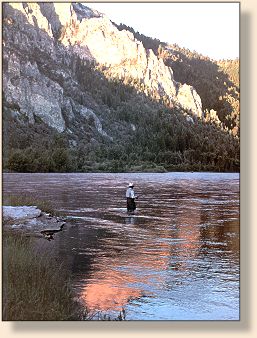 In eastern Idaho isolated livestock and agricultural activities started in the
1840s. Widespread occupation started in the 1860s with the dispersion
of peoples to the Snake River Plain and to the highlands in present day
Franklin, Oneida, Caribou and Bear Lake counties. It was a harsh life
for these pioneers, and in order to survive, natural resources had to be
utilized to the fullest extent. By 1870s impacts the on the cold water
fisheries had begun. Vast herds of cattle and sheep ranged along the Lander,
Oregon, and California trails, and up the South Fork of the Snake River
causing bank erosion and riparian zone destruction, providing a growing
threat to the quality of lakes and streams. On the Snake River Plain more
and more water was being diverted from streams for agriculture resulting
in the loss of both habitat and fish. Settlement of Teton Valley, the Lost
River valleys, and the Swan and Grand valleys of the South fork of the
Snake River was next. Last came settlement of more remote areas
away from the Snake River Plain.
In eastern Idaho isolated livestock and agricultural activities started in the
1840s. Widespread occupation started in the 1860s with the dispersion
of peoples to the Snake River Plain and to the highlands in present day
Franklin, Oneida, Caribou and Bear Lake counties. It was a harsh life
for these pioneers, and in order to survive, natural resources had to be
utilized to the fullest extent. By 1870s impacts the on the cold water
fisheries had begun. Vast herds of cattle and sheep ranged along the Lander,
Oregon, and California trails, and up the South Fork of the Snake River
causing bank erosion and riparian zone destruction, providing a growing
threat to the quality of lakes and streams. On the Snake River Plain more
and more water was being diverted from streams for agriculture resulting
in the loss of both habitat and fish. Settlement of Teton Valley, the Lost
River valleys, and the Swan and Grand valleys of the South fork of the
Snake River was next. Last came settlement of more remote areas
away from the Snake River Plain.
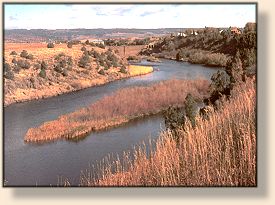 Dams to provide hydro power to growing populations were also built
including Ashton Dam on the lower Henry's Fork, Felt Dam in Teton
Canyon, Soda Point, Grace and Oneida dams on the Bear River, and
dams on the Snake River to serve Idaho Falls. Later more dams were
constructed to store water, provide hydro power, or for flood control.
These included Palisades Dam on the South Fork of the Snake River,
Ririe Dam on lower Willow Creek, the ill-fated dam on the Teton River,
and Gem State Dam on the Snake River below Idaho Falls. All these
dams have not had entirely negative impacts on the streams hosting them;
however, each has forever changed the stream on which it was built - and
more dams are planned for eastern Idaho's rivers.
Dams to provide hydro power to growing populations were also built
including Ashton Dam on the lower Henry's Fork, Felt Dam in Teton
Canyon, Soda Point, Grace and Oneida dams on the Bear River, and
dams on the Snake River to serve Idaho Falls. Later more dams were
constructed to store water, provide hydro power, or for flood control.
These included Palisades Dam on the South Fork of the Snake River,
Ririe Dam on lower Willow Creek, the ill-fated dam on the Teton River,
and Gem State Dam on the Snake River below Idaho Falls. All these
dams have not had entirely negative impacts on the streams hosting them;
however, each has forever changed the stream on which it was built - and
more dams are planned for eastern Idaho's rivers.
|
|
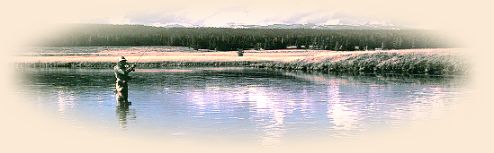
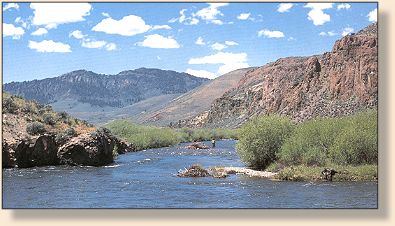
Trunk StreamsStanding on the most southerly and not too lofty Manan Butte one gets a perspective of the trunk stream system of eastern Idaho. Facing east, the South Fork of the Snake River in a verdant fringe is seen flowing almost straight across the plain from its canyon between the Big Hole and Caribou ranges. From its course irrigation canals radiate like branches from the trunk of a tree. On the north horizon one sees Big Bend Ridge through which the Henry's Fork cuts after it gathers its sources in the Island Park area. To the northeast the Henry's Fork, tapped by irrigation canals, turns in slow arcs through the plain to its confluence with the South Fork, almost at ones feet. To the native east Idahoan this is the start of the Snake river. Facing south one sees it flow west around the butte then arc southwesterly into the blue haze of the plain. On it flows through the monotonous flats accepting first the remnants of Willow Creek then those of the Blackfoot River. On through the degraded cottonwood forest above the broad expanse of American Falls Reservoir it courses. Here it pauses and takes in the Portneuf River and numerous spring creeks before plunging more westerly to exit eastern Idaho. For more than a century the trunk streams have supplied life-blood water to agricultural activities, industries, and towns in the Snake River Plain. These activities in turn have had a profound influence on the trunk streams and their trout populations . . .*Publishers Note: The following waters are covered in detail in this book. Space prohibits covering each of them in detail here.
DrainagesTrunk Streams: About The Flies
|

*Publishers Note: Snake River Country has 32 pages of flies, including color photos of each, the recipe and additional comments on the insect it imitates and where it is fished and how. Space prohibits covering each of them in detail here. However the following fly is representative of the information given for each of the included flies.
Speckled Biot Spinner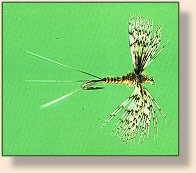 Hook: Tiemco 100 or equivalent, size 16.
Thread: Cream nylon. 6/0 Tail: Four or five still grizzly cock hackle fibers. Abdomen: Light tan goose biot. Thorax: Light tan dubbing. Wings: Pair of gray Hungarian Partridge hackles, tied spent.
Credits: From the Snake River Country, published by Frank Amato Publications. We greatly appreciate use permission.
|
 For a MAP of the Snake River Country, click