|
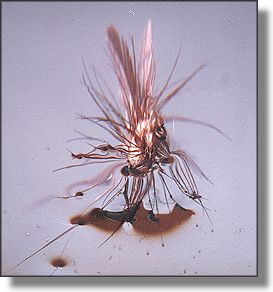
I will start off with a picture of the fly I tied
in section nine taken from below. The fly was
positioned ahead of the edge of the window. You
may remember seeing this same 'foot-print' pattern
in a previous section. This was the first tied fly
that had the same pattern as a natural.
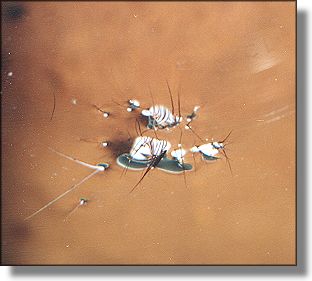
Notice even though I over-tied the body, it still
does not show in this view.
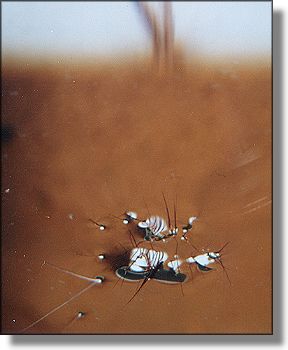
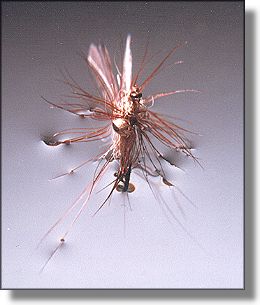
The next image is a classic. It dramatically shows
the division of images. As you can see, it is nearly
on the edge of the window. The 'foot-print' pattern
which is a 'keying' element for the trout is clearly
visible. The 'blind' section could not be more
pronounced and the wing tips are readily visible
tipping into the window at the top.
The third photo shows how the fly would look to the
trout at the moment of a take. Years of study and
other photographic evidence support the angle of
the take and place it exactly on the windows edge.
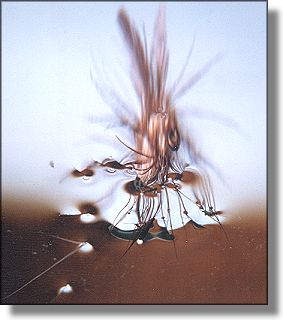
Below is a view of the fly as it leaves the window
edge, showing only a trace of the edge below it. At
this point the trout would most likely have let it
pass over. To rise with the fly this vertical would
cause the fish to be driven with the current. Not
a practical action.
Finally we can see the fly from directly below. From
this vantage it does not look remarkably different
from many other forms of tie. By this time the trout
has most assuredly let the fly pass.
The above series of photos gives dramatic evidence
of the 'thorax' style of tie exhibiting a unique
visage from the trouts domain.
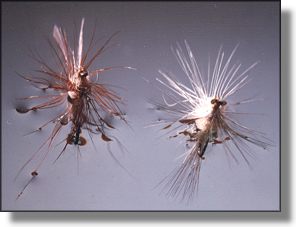
At this point I took another set of pictures, three
shots from below with two flies side-by-side. On the
left is the thorax fly, on the right is a regular tie.
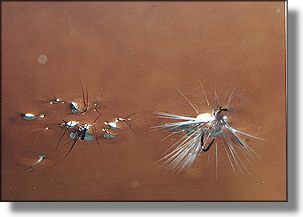
You can easily see the difference between the two.
Below is the next picture of them as they are on
the edge of the window.
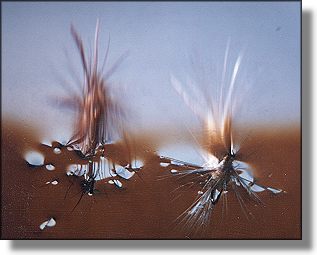
Remember, the trout has made up his mind before the
flies get to the window edge. The final shot is with
both flies nearly overhead. This is not a taking
position, but rather only for observation of the two.
*As this series was created thirty years ago, I do not
have any pictures of the today's method of tying so
called 'thorax-style' flies by simply cutting some
of the hackle from the bottom of the fly. These had
not been invented yet by fly-tiers too lazy or too
inept to tie them properly. I have personally viewed
these in the slant-tank however and they in no way
present the correct image at any of the positions.
These abominations are more closely related to faultily
tied parachute or comparaduns. A better name would be
not an emerger but an abortion.
In the next section we take this a step further.
J. Castwell
Back to Index
If you would like to comment on this or any other article please feel free to
post your views on the FAOL Bulletin Board!
|