Building A Cane Rod, Part VII.
 Well, we've reached the homestretch of the building process and all that
remains is to fashion the grip, mount the reel seat, wrap the guides and
varnish the rod. This is not to mean that these steps are of lessor
importance then all of the preceding processes. In fact, it stands to reason
that given blanks of equal quality, the skill and care with which the
finishing steps are performed will make a major impact on the quality of the
finished rod. Today there is far more emphasis on fine finish work a then
ever before, and in most cases rods made by skilled builders far surpass
vintage rods in this respect.
Well, we've reached the homestretch of the building process and all that
remains is to fashion the grip, mount the reel seat, wrap the guides and
varnish the rod. This is not to mean that these steps are of lessor
importance then all of the preceding processes. In fact, it stands to reason
that given blanks of equal quality, the skill and care with which the
finishing steps are performed will make a major impact on the quality of the
finished rod. Today there is far more emphasis on fine finish work a then
ever before, and in most cases rods made by skilled builders far surpass
vintage rods in this respect.
A huge amount of the credit for elevating the craft of rod finishing to the
level of art goes to the late Tom Maxwell and Tom Dorsey. Working together to
establish the Thomas and Thomas Company, they were pioneers in looking at the
cosmetic appearance of a rod in a different way-from the perspective of the
artist. The details of form, proportion, color, and texture were all
considered along with the technical skill necessary to do take this work to a
new level. Much as an artist or musician draws various influences into their
repertoire and then combines these ideas with skill and taste, they developed
their own unique style and set a new standard for the quality of this work.
The finishing steps provide the maker with an opportunity to be creative and
impart their personality and individuality into their work, and in an
artistic sense this can separate the exceptional from the mundane. The best
rodbuilders pay attention to these details both out of pride and a desire to
express themselves in their own unique way. The development of an
identifiable style can allow a knowledgeable person to scan a mixed rack of
rods from across a room and immediately recognize who built every rod in the
rack.
The first step towards finishing the rod is to mount and turn the grip. Cork
is supplied to the rodbuilder as individual rings, usually 1 ¼" in diameter
by ½" thick, with a ¼" bore. Most cork is grown, harvested and processed in
Portugal and is actually the bark of the cork oak tree, Quercus suber. This
amazing plant is unique in that the bark can be carefully stripped without
damaging the tree. A cork tree must be 25 years of age before it can be
stripped for the first time and can be stripped every nine years thereafter.
Some cork trees can continue to be harvested for over 200 years!
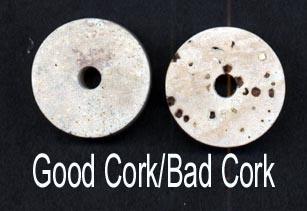
The number and sizes of the spaces present determine the grade (quality) of
cork across the diameter of each ring. Because cork has many uses and a
limited supply, premium grade rings are expensive. It is a surprise to most
people that other then the ferrules and real seat on a cane rod, the cork in
the grip can represent the next highest investment in materials. Today,
conscientious builders use a higher grade of cork then found on vintage rods.
Although there is some degree of uniformity between different manufacturers
with respect to the grading system, the grading can at best be termed
subjective and even bags of high priced cork contain a few 'clunkers'.
To fashion the grip the cork rings are bored out to allow the rings to be
slid into position on the rod shaft and simultaneously glued together and to
the blank. A jig called a cork press is used to push the rings securely
together. Once the glue has cured the rod is placed in a lathe to turn the
grip. The rotating cylinder is first trued and then the shape of the grip is
imparted. The shape can be fashioned by elaborate tools or simply by hand
using progressively finer grits of sandpaper.
The shape and size of the grip is determined by both practical and aesthetic
considerations. A well-made grip has pleasing size and symmetry and appears
to flow naturally from the rod shaft to the reel seat. In addition, the grip
should be in proper proportion so that the rod is both comfortable to cast
and controllable at all times. This is an area where individuals have their
own preferences about what constitutes an ideal grip and the cane rod builder
can work with the customer to reach a satisfactory solution. As a general
rule, larger rods have larger grips and smaller rods, smaller grips. This
helps to achieve both comfortable function and pleasure to the eye. There are
limits however, as a large bulky grip on a light weight rod can ruin its
appearance just as much as a diminutive grip on a large rod may render it
uncomfortable to cast and control. ~ J.D. Wagner ~
© 1999, J.D. Wagner, Inc.
|