Trout Stalking
(Or Discovering Silk Fly Lines)
By Reed F. Curry
Photos by Rachel Curry
My search for thinner, suppler, better
flylines began the day I discovered that the line/leader loop
of an expensive DT6F line wouldn't fit through the last few
diminutive snakes of a new-to-me '30's vintage cane rod. To be
honest, there was another spur to the search, the simple
realization that, if cane had properties more modern materials
lacked, it was probable that other excellent fishing tools had
been left behind in the relatively recent wash of technology.
The result of my research was a return to a material carried
from the same land as the cane itself – Silk. Since I tried my
first silk line some years ago, I've learned the relaxing rhythm
of a 100 year old wet fly rod that had been merely a sullen stick
with a modern plastic line draped on it; I've come to delight in
the new sight and sounds of casting, the translucent honey-colored
line cutting the wind, the gentle laydown of the silk line's delicate
tip onto the surface film; and I've shared the pleasure as a friend's
new cane creation suddenly came alive in his hand, casting more line,
with less effort, than ever before. Does this all sound just a little
incredible? After all, it's only a fly line. . .
Lines Shaped Fly Rods
The evolution of fly lines determined, to a large degree, the
shifting design characteristics of fly rods. This was evident
as early as the 1890's when oiled silk replaced horsehair-and-linen
lines and the miniscule flip-ring guides were replaced with the
modern snake guides. For, with snake guides came the ability to
"shoot" line; and with oiled silk came the opportunity to float
a dressed line, opening the way to the use of the dry fly. That
was his intent when Frederic Halford, the "Father of the Dry Fly"
developed and patented the first solid woven tapered silk fly lines.
But this new Dry Fly fishing in turn required a slightly faster
rod to handle the false casting necessary to drying the early,
soft-hackled flies.
Silk was the premium line during the early years of dry fly fishing
and the "Golden Age" of rodmaking; and it met all the requirements
of the day. But with the end of the Second World War the new miracle,
"Nylon," was marketed as a possible substitute for silk. It had
proved satisfactory in parachutes and stockings, why not flylines?
Initially, the Nylon line was oiled and honed like its silk counterpart,
and required much the same care. Enter the 1950's, the age of Science
for Convenience, Inventions liberating the Common Man (and Woman) from
the drudgery of maintenance and care; Automatic Washers, Self-Cleaning
Ovens - and plastic, no-maintenance flylines. The man just returned
from war and building a family had little time to spend at streamside,
so the appeal of anything that optimized his fishing hours was great.
However, it was a mixed blessing, for the advent of synthetic flylines,
comprised of a uniform hollow nylon core covered with a tapered Polyvinyl
Chloride (PVC) finish, triggered a rapid and serious degradation in fly
rod taper and action. The reason for this may be found, principally,
in the word "Diameter."
Size Does Matter
The increase in diameter of flylines began innocuously enough.
The early oiled-Nylon line was as much as 40% lighter than the
silk, not an advantage for casting, and quite confusing to the
anglers who bought their lines by the diameter, not the weight.
[For those unfamiliar with the Letter Codes an "I" line was .020"
in diameter, "H" was .025", and so on. HDH signified a Double Taper
with a belly of .045" tapering to .025" at the ends.] An HDH rod,
as rated for Silk, took an HCH or GBG diameter Nylon line, and this
bulkier line, with its greater air resistance, required more effort
to cast. Since these lines gave no great advantage to the fishermen
in terms of usability, they did not achieve wide popularity. The
oiled Nylon quickly gave way to the "transitional lines" that had a
tapered Nylon core sheathed in plastic. However, these lines floated
poorly and the plastic coating tended to strip off, due to the
difference in elasticity between the coating and the braid. The
next step to modern lines came with the use of a level Nylon core
and a tapered coating of Polyvinyl Chloride. This and the subsequent
invention by Scientific Angler of the "microbubble" to achieve
floatability bring us to our modern plastic lines.
The new line floated admirably (except the tip), but this buoyancy
was produced by reducing the specific gravity, and increasing the
volume of the line. The old method of using diameters to determine
the line for your rod became impractical; the difference in specific
gravity between the old silk and the new PVC, and even between one
plastic line and another, was too great. In order to provide a
meaningful method for determining the line load for a given rod,
a new system was developed which referred to the weight of the line
rather than the diameter. Diameters were thus free to expand… and
they did. In order to float the tips, which had the same size core
as the belly, the delicate .020" ("I") tips of the oiled Silk line
gave way to .035" or greater for the PVC line. To drive these lines
through the air required a stiffer rod, larger guides, and a much
different method of casting. The reason for this is obvious, the
larger diameter lines had tremendous air resistance that could only
be overcome by more energy from the caster. The days of relaxed
casting with subtle wrist action yielded to the "high linespeed"
arm waving school, as anglers struggled to make the ever more
bloated PVC lines load the rod.
Line Types
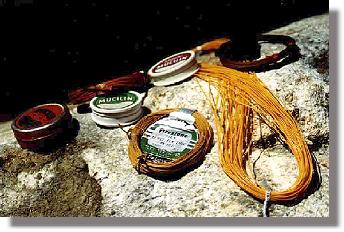
To those persons familiar with them, a "Silk fly line" refers to
a braided, oiled, silk line, usually vacuum-dressed and hand-honed
(rubbed carefully with fine abrasives to level the oil/varnish
coating). This should not be confused with the hard "enameled"
silk lines that were popular for a time late in the 19th century.
The enameled lines wore quickly, seldom lasting more than one season,
whereas a well-constructed oiled silk line can endure decades of use.
Within the realm of oiled silk there exist different braiding patterns,
producing what are known as "hard", "medium", and "soft braid". The
hard will shoot and wear better, but the soft will be more supple
and forgiving when striking large fish. The early writers recommended
the hard braid for most trout sizes (up to "C") and the medium or
soft braid for the larger sizes. Of far greater importance, of course,
is the taper of the line itself. Silk lines have been made in as many,
or more, varied and sophisticated tapers than modern plastic lines.
The subject of line tapers and creating your own unique tapers, is
beyond the scope of this article, but fascinating, nonetheless.
The Wind
The thinner diameter of the silk line is immediately noticeable as
you line it on your rod for the first time. If your rod took a PVC
DT5F and you use a DT5 silk you will be surprised at the difference
as you start false casting; you might even need to go down to a
DT4 because the decreased air resistance makes loading so much
easier. The front taper has more weight and starts to load the
rod almost immediately. As more line is worked out, you'll notice
that less effort is required to sustain it in the air. And if a
wind comes up, you'll be able to cut through it with greater effect
than ever before. Now start shooting the line. The noise may be a
bit disconcerting at first; the rustling, hiss as the braid murmurs
through the guides. The shoot, however, will make you soon forget
that.
One of the more curious developments of recent years has been the
braided leader. This was created, I assume, because the thick,
stiff tip of the plastic line has a tendency to slap down into
the water; especially because of the need to generate a high line
speed in order to get full extension of the light PVC line.
The braided leader emulates the tapered end of a silk fly line.
With the terminal end of an "IEI" miking at .020" it is thinner
than some monofilament leader butts, and it has the smooth laydown
that the braided leaders were designed to deliver.
You'll probably quickly notice that your silk line is suppler than
plastic and has less tendency to memory (no more of those annoying
coils that grab at your reel handle). This is because the PVC line
is essentially a semi-rigid pipe (in larger sizes it's the plumbing
for your bathroom sink). The silk, on the other hand, is a thin
rope. Think about it.
The next discovery you'll make will occur when the silk line lands
gently on the water. . .it floats higher than your plastic line.
Approaches to Floatation
The specific gravity of a PVC line is less than 1.0; silk lines
run 1.2 – 1.4. Yet, the silk floats higher. This is possible because
the lines use different approaches to floatation. Modern PVC floating
fly lines achieve buoyancy through displacement. Archimede's Principle
at work, the line must displace a sufficient volume of water to
compensate for its weight; and to do this it must settle deeply
into the water. The silk line relies upon the same principle as
the floating artificial fly … surface tension. The dressing applied
to the line repels the water, floating the line high on the meniscus.
Thus, the silk line is easier to lift from the water, and creates less
surface disturbance in drawing it back. This is especially evident in
the ease of rollcasting.
The tips of most plastic lines float rather poorly. The specific
gravity of the PVC line increases as the volume of the "microbubbles"
decreases. Obviously, with less volume to keep it afloat, the tip of
the plastic line sinks when the invisible coating of dirt and algae
accumulated during a normal day's fishing overcomes the designed
buoyancy of the tip. Not so the silk line, the delicate 0.025 tip
floats in the film.
. . .And Now, the Downside
But, there is the cost. I've only found two manufacturers, one in
France, one in England (see sidebar); both produce only double tapers.
A new DT4 made by Phoenix runs $210. Of course, as the U.S. distributor
points out, this line, with care, will last 20 years. In 20 years I
would go through 10 PVC lines (let's see, 10 * $45 = $450), yes, I
can rationalize the higher initial cost of silk. I have no experience
with the Phoenix product, so I can't tell you what the tapers are like.
There are great lines with good tapers are out there, and they cost
as little as a few dollars. They might look a bit rough, initially,
gummy and black on an old skeleton reel at the local flea market;
but given the right TLC, you'll have a line good for years of use.
Weight forward lines in weights as light as IGH (approximately a WF2),
or as heavy as GAAF (WF10) are out there; I've found both, and more.
You might chance upon one of the sophisticated tapers of specialists
like Marvin Hedge, or an old Halford. Remember, silk was the only
line material for the fly fisherman for almost half a century, there
are quite a few of those lines still out there. Techniques for
recognizing and restoring silk lines will be the subject of another
article. A little preventive care, such as we give our cane rods,
will ensure a supple, pleasurable line for years to come.
From Some Cane Rodmakers, and Others "With the tutelage of Reed Curry I got an old sticky flyline
cleaned and restored. I just got back from fishing it. Works great.
Floats like a cork (Mucilin red label treated) and really presents
the fly with barely a ripple. I was in a wild trout area, but
unfortunately the first fish I caught with it was a stocker, but
it did give me a good fight, it was about 12". Must have wandered
in from downstream where they do stock the stream. This was my
first time actually fishing with a silk line. I really like it!
It doesn't stretch as much as a plastic line and hook sets are
much more positive. And I really like the way the line feels and
sounds as I cast it. There really is a different feel to silk
lines, much like there is a different feel to bamboo rods. The
combination of the two is too good to be described."Hayashida (a
cane rodmaker from California, whose "SirD" taper is increasingly
popular around the globe.)
"I really think that anyone who is using bamboo today and hasn't
tried silk lines is doing themselves and the rod a disservice. A
silk line makes a bamboo rod come alive. The key to using silk is
understanding how to care for the silk lines and their use. Once found,
they are a pleasure to use and only require the same care as you would
give a good bamboo fly rod." Chris Bogart (A Shenandoah Valley cane
rodmaker who haunts the mountain streams armed with a 7' 2wt "Yellow
Rose" - and silk line.)
"Whenever I finish a new taper and the rod feels like there's
something missing I will try a silk line on it. Makes them feel
like a different rod. I think that it has a lot to do with the
diameter being slightly smaller in a silk line than a modern line.
Also the finish is a bit slicker and harder, this stuff can really
shoot, not to mention little or no line memory. The only draw back
I have found so far is the maintenance. Can't just roll it up on
the reel and forget about even for a day. (they can begin to mold.)"
Lohkamp (a Portland, OR cane rodmaker who fishes the lower Deschutes
with a 5wt silk.)
"Silk lines had a lithe and supple poetry about them, partially
because of their inherent properties, and partially because they
are heavier than nylon lines of the same diameter."
Schweibert "Trout Tackle – One"
"I will, however, also want a few silk lines that I can grease up
for high-floating and easy pickup. . ."M. Wright "Dream Tackle"
from "Fly-Fishing Heresies" 1975.
"After trying many types of lines I have gone back to the old,
hard-to-get silk double taper. This is not because of contrariness
or nostalgia, but because this line performs better in every way.
Silks don't shoot as well as the glassier floaters, but trout fishing
is seldom a distance contest. They are denser than the synthetics
so they cheat the wind better and they have tips that are 20 to 25
percent finer. This finer point not only disturbs the surface less,
but also means you can use shorter, more manageable leaders. When
greased properly silks actively repel water and can be picked off
the surface for the backcast with less disturbance than a line that
floats only because it is a bit lighter than water. Then too, the tip
floats and I have yet to find a floating line on which the last few
feet of line doesn't sink." Wright "More Sensible Tackle" from
"Fishing the Dry Fly as a Living Insect" 1972 |
A silk line must be dressed with a floatant before starting the
day streamside. The subject of line dressings used to be good
for an hour's argument at fishing lodges anywhere in North America;
deer fat vs. bear fat, turps vs. mineral oil, etc. I eschew all the home
recipes, especially the animal fats which cause oxidation of varnish
and tackiness. I stick tenaciously with Red Tin Mucilin; never the
Green Tin, though I have no reason to avoid it. Perhaps, its just part
of the tradition; or childhood memories of struggling to open that red
tin with wet hands and watching the cover go spinning off into deep
water. Someday, I'll try some experimentation with non-traditional
floatants; for example, I've used Albolene, but found it too greasy,
and I may try Sno-Seal, since it's wax-based.
How you apply the mucilin is a matter of preference. Some use their
fingers; I prefer to use the felt pad that comes with the mucilin. Always
remove any excess, you only need a very thin coating. You can buy
gadgets to perform even this task; and fishermen love their gadgets.
But the best, most versatile implements you might carry are a bandana
to remove excess mucilin, and an 8" square of chamois to dry your
line (and flies). You would want to pull the line through the chamois
during fishing if the line starts to sink – this will give you another half
hour of casting before you retire that end of the line for the day.
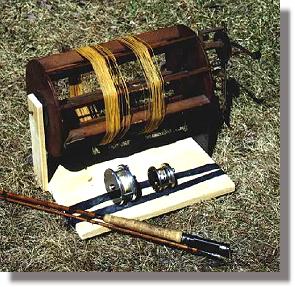 You'll find that it is handy to have loops, for line to leader connection,
on both ends of a DT, and a large enough loop in the backing line to
permit you to pass the reel through. Over the course of a days fishing,
perhaps within four hours, an oiled silk line, like an oiled dry fly, will
have absorbed sufficient water to cause it to sink. At this point you
ave a number of options. If you have a concept of flyfishing as the
"Contemplative Sport" you might unspool your line onto the bushes
at streamside, boil a pot of tea, and have a pleasant lunch while waiting
for the afternoon hatch. Of course, (if you're using a double taper) you
might just switch the line end for end; dropping the reel through that
large backing loop and rush furiously back to the water. Whichever
approach you take, before you drive home, strip the line in loose coils
onto the back seat of the car. In most climates it will dry overnight.
If you fish more than one line in the course of a day or keep a dog
in the backseat of your car, you may want to get a Line Drier.
Ultraviolet light does not have a deleterious effect upon silk lines, as it
does with PVC. The enemy of silk is mold. Keep your lines dry when
not in use. An invisible fungal attack (read "rot"), from leaving the line
stored wet, may reduce the breaking strength of any silk line to just a
few pounds.
You'll find that it is handy to have loops, for line to leader connection,
on both ends of a DT, and a large enough loop in the backing line to
permit you to pass the reel through. Over the course of a days fishing,
perhaps within four hours, an oiled silk line, like an oiled dry fly, will
have absorbed sufficient water to cause it to sink. At this point you
ave a number of options. If you have a concept of flyfishing as the
"Contemplative Sport" you might unspool your line onto the bushes
at streamside, boil a pot of tea, and have a pleasant lunch while waiting
for the afternoon hatch. Of course, (if you're using a double taper) you
might just switch the line end for end; dropping the reel through that
large backing loop and rush furiously back to the water. Whichever
approach you take, before you drive home, strip the line in loose coils
onto the back seat of the car. In most climates it will dry overnight.
If you fish more than one line in the course of a day or keep a dog
in the backseat of your car, you may want to get a Line Drier.
Ultraviolet light does not have a deleterious effect upon silk lines, as it
does with PVC. The enemy of silk is mold. Keep your lines dry when
not in use. An invisible fungal attack (read "rot"), from leaving the line
stored wet, may reduce the breaking strength of any silk line to just a
few pounds.
Strength is a factor to consider in using a silk line, though this is not
generally of much concern. Our grandfathers were able to land 40 pound
Atlantic salmon on their silk lines. . .but they were using gut leaders.
Unlike gut, the modern tippet material is of both fine diameter and high
tensile strength. This could easily permit you to use a tippet that was
stronger than your line. The breaking strength of an HEH silk, dry, is
from 14-18 pounds; when wet, the same line would actually test a few
ounds higher for sudden stress. This, of course, is adequate for most
situations. If, however, you insist on fishing with a tippet testing more
than 12 pounds, don't use silk. Salmon lines would usually be GAF or
larger, and these test out at greater than 20 pounds; but, again, the tippet
used should be 12# or less.
Change is a constant. But sometimes looking back at what we left behind
may serve us well. Try a silk on that favorite cane, you won't
regret it. ~ Reed F. Curry
© 1998 Reed F. Curry
|