
| |||

|

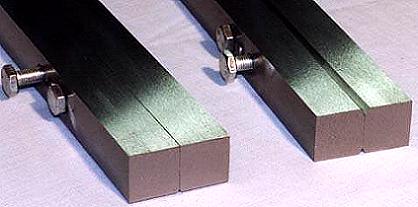
The planing form consists of two parallel steel bars with a sixty-degree groove
running between the two bars along the length of the tool. One side of the
form has a relatively deep groove for forming large strips for butt sections;
the other side has a shallow groove for forming tip sections. It should be
noted that a typical rod tip may measure only about .060 inches, and therefor
an individual tip strip is a mere wisp of bamboo measuring about .030 of an
inch! The sixty-degree groove is tapered- it becomes progressively deeper from
one end of the form to the other. In addition, the depth of the groove in the
planing form can be adjusted by means of screws that push or pull the forms
apart or together. These adjustment screws are located every five inches
along the form's length and correspond to the convention of rod tapers being
determined at five-inch intervals.
|
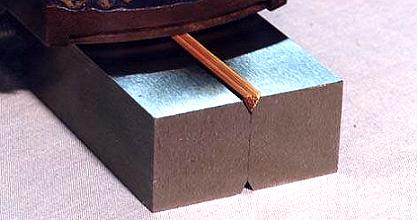 The equilateral form of the strip conforms to the shape of the groove. The hand plane is then used to shave off the excess cane above the surface of the form. Once the strip has been planed down to the surface of the form, the size of the strip is a mirror image of the depth that has been set in the form. The tapered strip is now referred to as a spline. This process is then repeated to plane the taper into the five remaining strips.
© 1999, J.D. Wagner, Inc.
|