Building A Cane Rod

In this series of columns I hope to give folks an understanding of how cane
rods are constructed. Although many rods being built today are built using
only hand tools, the majority of classic rods were built with the aid of
machines, and so I will also address the use of machines in rodbuilding. Some
steps in the construction of a cane rod are also done differently from
builder to builder, but overall the procedures are essentially the same.
Despite some of the hype and 'romance' associated with building a cane rod,
the essence of cane rod construction is simply forming a series of tapered
cane strips and then gluing these strips together to form a blank. There are
no great mysteries or magic involved in the process. A rod may be composed of
any number of tapered strips. Most common are rods of six-strip design
(hexagonal cross section, or 'hex construction'), followed by rods of four
strip construction (square cross section or 'quad construction). As I
mentioned in a previous column, rodbuilders have experimented with a number
of strip configurations but the vast majority of rods continue to be built
with six-strip construction.
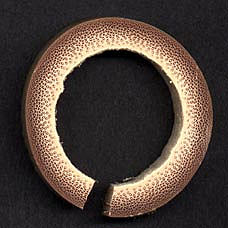
All rodbuilders start with the same material: a tube of dried grass, Tonkin
cane. The walls of the cane consist of three layers. The outermost layer is
called the enamel. It is very thin and serves to protect the vessel elements
within, much as bark protects a tree. Just under the enamel are the cells of
interest to rodbuilders, the 'power fibers.' The power fibers are what give
the cane its strength and are densest near the enamel surface. In addition,
the thickness and density of the power fiber layer is greatest near the butt
end of the bamboo and becomes gradually thinner as one progresses up the
plant. This is simply what one might expect-the denser and heavier portions
near the ground must support the rest of the plant above. The power fibers
also become less densely concentrated toward the center of the bamboo and
gradually give way to a white, chalky layer of inner pith. The pith portion
has no strength and is so soft it is easily scratched with a fingernail.
Because the enamel has no strength and forms an opaque covering to the
beautiful 'grain' of the power fibers below, it is removed at some point in
the construction process by sanding or scraping. As the power fibers are
densest at the periphery, the cane that will be removed to form the tapered
strips is removed from the inside surfaces. This insures that the when the
individual tapered strips (also known as splines) are glued together the
resulting rod section is composed of as much power fiber as possible.
The raw culm of bamboo may be left in its natural state prior to further
processing. Such a rod, with its familiar yellow color is known as a 'blond'
rod. A rodbuilder may also choose to flame the raw culm of bamboo with a
torch or other device. Depending on the amount and duration of the heat
applied to the culm, the finished rod can vary in appearance from light brown
to almost back in color. In addition, the heat may be evenly applied over
the length of the culm or applied in a more patterned fashion to produce a
mottled or striped appearance.
The resulting cosmetic appearance of the rod, blond or flamed, can become a
part of a rodbuilder's 'signature,' and may be a reflection of their beliefs
or training about what makes a rod beautiful. On the other hand, some
rodbuilders may allow the customer to decide on the appearance. In addition,
some builders (ourselves included) believe that flaming the cane tempers the
fibers to produce a rod that feels a little crisper and more resistant to
taking 'sets,' so there is a reason beyond cosmetic appearance why some
makers flame their cane.
Each step of the building process represents a choice for the rodbuilder and
when evaluating any cane rod you may wish to bear this in mind. Each of these
choices becomes in effect the 'story' behind the rod and the person(s) that
built it and are a reflection of many factors. Everything is done for a
reason. If each time you look at a cane rod you ask yourself or the builder
'why?' you may stand to learn much more then you bargained for and gain more
insight into the craft and our angling tools.
~ J.D. Wagner
|