Dry-Fly Fundamentals and Tackle, Part 2
Excerpt from Chapter 7 Trout
By Ray Bergman
Published by Alfred A. Knopf (1938)
This is possible you know. One salesman I knew
well who rarely fished for trout instinctively knew a good
dry-fly rod the instant he felt one and it was seldom that
his judgment was at fault. This skill had come from many
years of experience in catering to customers who knew rods
and who know what they wanted.
On the other hand, when you find a salesman who
had the angling as well as the merchandising experience, you
will find a certain sympathy that is hard to beat, as well as
someone who really knows what it is all about.
Remeber this. The fellow who really knows things will
not try to impress you with his knowledge. Only those who have
limited experience are likely to do that. The experience
of years and the knowledge gained from it are ingrained in the
personality of the possessor. You don't need to be
told if a fellow really knows anything about fishing. You sense
it after talking to him only a few moments. We who have fished
for a good many years can tell the moment he takes a rod in his
hand if a man is a fly fisherman. The way he handles it
immediately tells the story far better than any words.
Many years ago I bought a seven-and-a-half-footer that
proved perfect as far as I was concerned. In the hands of the
average caster it would cast forty to fifty feet without undue
strain and yet was ideal for close work. It was accurate and delicate -
good for either a large or small stream. Since then I have purchased
three more - had them made to imitate the action of this original.
One was the unsuitable stiff rod previously mentioned, but the others were
positive duplicates. Every angler I have ever let try one has become
enthusiastic over their feel and performance, even though not one
of these anglers believed in a rod as short as seven and a half feet.
By actual test I have found that they will do everything that is
possible with an eight-foot rod and at the same time give you that
additional advantage of less length when on a brushy stream.
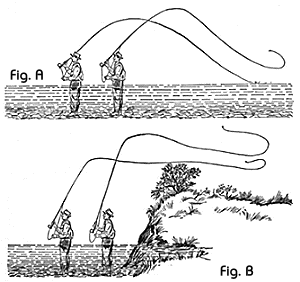
SHOWING A SHORT AND LONG ROD IN
ACTION under identical conditions and in hand of fair caster.
With the short rod the fly will catch on bush. With the long rod it
will probably miss it. Of course if you learn to keep your back-cast high,
which is most important anyway, you can get by with the shorter rod.
I have several objections to short rods for dry-fly
fishing. They are not satisfactory when it is necessary to wade deep - that
is in any water that reaches six inches or more above the knees. Most of
us when fishing are inclined to drop our backcast, and the deeper the
water the more this tendency causes trouble. A long rod aids in overcoming
this fault, which, even though it is correctable by casting, won't be corrected
by the average individual except by mechanical means. (See figure A above)
Natuarally, the longer the cast attempted, the greater the possibility of the line's
dropping because of the extra line weight in the air on the back-cast. In
addition, when the angler has a high background, (figure B) the longer rod
helps in lifting the line high enough to avoid snagging. But even more
important than these two things is the advantage you get from using a long
rod when standing in deep water when it comes to lifting the fly from the
water at any considerable distance for the next cast. ~ Ray Bergman
Publishers note: We excerpt the previous, first published in 1938,
as a bit of a comparison to where rod building and fly fishing is today.
And to note, some things never change! Concluded next time.
|