Building a Bamboo Rod
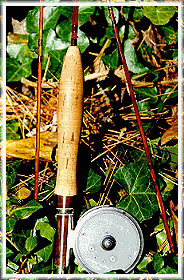
By Brian Toman
The Chattahoochee River Rod Company
January 11, 1999
Ever since I'd heard about bamboo fly rods, I'd wanted one. It didn't
matter that I'd never seen or cast one, I just had to have one. I
couldn't justify the price tag of a new rod so I figured I was going
to have to build one myself if it was to be more cost effective.
I was able to research and find everything I needed to begin
building a rod on the Internet.
The most important part of building a rod is gathering the tools.
Go ahead and spend the money on quality tools, believe me you'll
be much happier when working with them. I decided to spend the
$300 - $600 on planing forms figuring the 40 or 60 hours it takes
to build would be time taken from the actual rod building. I
ordered the bamboo from a company in New Jersey, the only
importer of Chinese Tonkin Cane in the U.S. at the time. After
about three weeks I had everything to begin and the hard part was
over.
The rods themselves are easy to build although it consumes
quite a bit of time. The first rod took 60 - 70 hours because
I played around with finishes, which added to the time. Recent
rods have taken 35 - 40 hours to build.
I begin the building process by burning the enamel side of the
bamboo culm so black with a blowtorch you'd swear it was ruined.
It's then split with a Buck knife and a six-inch piece of 2x4.
The six strips are then cut to size (carefully choosing my node
alignment pattern). If too much is taken off the strips, splices
may need to be made to add back some. Once the strips are cut
to size the nodes are filed before heating them over the eye of
the stove and pressing them in a vise.
Planing is done with a hand plane and a set of forms. Forms can
be made from wood (they don't last too long though) or cold-rolled
steel. Rodmakers of today measure a rod by taking the diameter
of a finished rod every five inches from the tip, which is then
halved to come up with the individual strip dimension. The forms
have an adjustment every five inches to accommodate this, so the
depth is set to the strip dimension (plus .002 for the enamel
thickness) at every setting. I use a Record 9 1/2 hand plane
with a Hock blade, which holds an edge longer than a regular blade.
The blade must be razor sharp and make sure that you keep a
straight 60 degree angle on all sides of the triangular strip.
Once I hit the forms a couple of times with the plane I switch
to a Lie Nielson scraper to remove the last .005 inch.
After the strips are planed I use an epoxy to glue them
together in the familiar hexagon shape. I wrap the freshly glued strips with
sewing thread by hand although most builders today use a binder
of some sort.
I straighten them as best I can before hanging
them overnight to dry. Depending on the curing time of the glue
used, the next step involves using 300 grit sandpaper to remove
the thread, glue and enamel which will reveal the power fibers.
Some builders use a scraper to speed up the process but it can
leave chatter marks on the rod. Once sanded, pure tung oil is
used to bring out the final look.
Ferrules require some work to point off the blades (a picture
would be worth a thousand words here) before being glued on with
epoxy. The ends must be sized to accept the ferrules, too.
The rod is then finished like any other with the grip, seat,
guides and windings.
For anyone interested in building there are a few books on
the subject. I would recommend Wayne Cattanach's book although
Garrison's book is considered by many to be the bible on bamboo
rod building. If anyone has thought about building rods and has
questions, don't hesitate to call me. For those who would like
information on a custom rod, please give me a call. Visit
my website
or call me at 303.805.5733. ~ Brian Toman
|