Forward to The Lovely Reed, Part 2
By Glenn Brackett
December 14th, 1998
Publishers Note: Glenn Bracketts forward to The Lovely Reed,
will appear in three segments. And is as Glenn provided it to us,
the original, unedited text. A review of The Lovely Reed appeared
previously here on Fly Anglers on line. Click
here to read it.
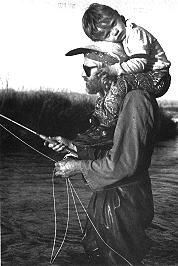 I'm not a hand-planed rod craftsman. My experience
lies with machining. So I'm out of water regarding hand-planing
techniques. However, after reading his book [The Lovely Reed]
I was moved to want to try hand planing because I feel it keeps
you in touch with the magic of cane, the lovely reed, as no other
approach can. And believe me, it is the magic at the rod bench,
and streamside, that keeps this unique craft alive.
I'm not a hand-planed rod craftsman. My experience
lies with machining. So I'm out of water regarding hand-planing
techniques. However, after reading his book [The Lovely Reed]
I was moved to want to try hand planing because I feel it keeps
you in touch with the magic of cane, the lovely reed, as no other
approach can. And believe me, it is the magic at the rod bench,
and streamside, that keeps this unique craft alive.
Whether you're new or old to this craft, Jack Howell has
handed us the keys to a wonderful world and way of live. In
these fast moving, complex, and demanding times, hand planing
a bamboo rod, and fishing, will help improve the quality of one's
life. It's good medicine.
I feel grateful to those who share their
knowledge about his craft. Howell is certainly among those. You
will find yourself a faithful follower, for there's truth, honesty and
something to believe in beyond what can ever try to express in
words or thoughts. Howell has done his best to orchestrate a
work that I'm sure will make you whistle and happily hum while
you plane, plane, away. Solice in the sawdust is a given. Without
a doubt, you'll experience dark moments. But the light of bliss will
always be there to guide you through it. Howell's bright light, (book)
has made it easier than ever before. He has struck a high note for
senseability of simplicity. He has taken the unneccessary complex
out of the craft that has for too long dominated. He will help to
bring you peace, and peace of mind.
The path is not easy. The investment of time, energy, and
emotion is more costly then imagined. But the feed back from making
the commitment and doing the work is unbelieveably rich in benefits,
i.e. soul saving for me. A former Winston associate, Chris Warner,
wisely wrote, "...so we try to use our hands to bring useful beauty to
the world. In that process, at lease, there is mercy, love, skill and
hope."
There's a Zen-like quality to it all. In someway the discipline
and ritual of the work touches deep inner cords. Rich self meaning is
revealed and experienced. Who knows, you might be guided by some
universal rod building force in the bamboo dust of the cosmos. For
me the physical work turns into soul work, from making rods to making
the soul sing. Rods by rout to rods by inspiration. This becomes soul
work - creative, inspired and spiritual. Howell will keep you true to
path, centered in practice.
As always, with a "how-to", many questions
will be left unanswered, many. The only way to answer these is with
experience, and believe me, you will never get enough experience.
My mentor, Gary Howells (no relation to Jack Howell), in my
beginning years, responded to my river of constant questions with,
"Glenn after you build your first 100 rods come ask me again."
There's no substitute for experience.
Howell does himself credit by not suggesting
he has all the answers and a foolproof way. That is the beauty and
truth of his work. Regardless of whether you take up this craft, or
not, Howell's book will help you appreciate what rewards and passion
are in it. There are no secrets, just damn hard work, and there's many
ways to "skin a cane" I've seen very fine rods produced by the
hundreds with very primative hand tools, jig etc., built faster than I
can with my sophisticated machines. It's best to be guided by the
fact there are no absolutes. Therein lies your first clue and lesson in
rod building. What works is the simple approach, try to stay away
from the elaborate, or unnecessary. That's what is being taught here.
Success will come through the doing not the thinking how to do
(differently). There's lots of pages to read through. There's no way
to by-pass or shorten the unbelieveable number of steps required.
But lots of second guessing has been eliminated. A great saving in
the learning, and grief curve. But it will never turn into a step-by-step
cake walk. Forget it~ You can also put too high a value on the
wrong things, i.e., blemish, straightness, nodes, finish, etc. but you
must always keep in clear focus that you are transforming something
that is natural, unique, with inherent characteristics into a fishin' pole
first and foremost. Perfection can not be achieved with something
natural. What condition you may be selecting for on one hand may
be selecting against another. The myth, and the tabos surrounding
this craft is part of its charm and mystique too. Howell has given
us a million dollar labor-of-love that he will never see much monetary
return.
The mystery of this craft is what you will be
caught by in Howell's writing achievement. As your mastery starts
to come so too will the mystery. The shaping of something beautiful
from something even more beautiful should be (the mystery) what
guides, and what matters. What Chinese winds once strenghtened,
moved, now is being moved by the hand of man in a redefined form.
From cane pole to cane rod. Nature's lovely reed lovingly modified
for our needs.~ Glenn Brackett
Next time, Part 3.
|