The Split Cane Fly Rod
(Excert from Part III: Research and Technique)
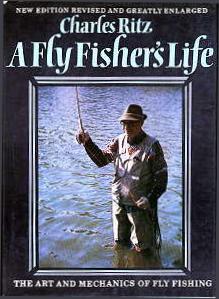
A Fly Fisher's Life (1959)
By Charles Ritz
Our sincere thanks to Crown Publishing Company
October 12th, 1998
 Publishers note: Since this
publisher is older than dirt, it occured to me that some may never have
seen many of the older books. From time to time, we hope to
excerpt interesting segments from our personal library to enlighten,
entertain and perhaps amaze our rod building friends. Some things
are older than you might think. Most of these books are long out
of print, and if we spark an interest in you, check out the used
book stores, or one of the mail-order book sellers. Armchair Angler
in Hillburn, NY is one we particularly like. We previously
ran a series on bamboo from Ring of the Rise, (check the archives)
which I understand is now available in reprint. Your suggestions
and comments are always welcome.~DB
Publishers note: Since this
publisher is older than dirt, it occured to me that some may never have
seen many of the older books. From time to time, we hope to
excerpt interesting segments from our personal library to enlighten,
entertain and perhaps amaze our rod building friends. Some things
are older than you might think. Most of these books are long out
of print, and if we spark an interest in you, check out the used
book stores, or one of the mail-order book sellers. Armchair Angler
in Hillburn, NY is one we particularly like. We previously
ran a series on bamboo from Ring of the Rise, (check the archives)
which I understand is now available in reprint. Your suggestions
and comments are always welcome.~DB
The Split Cane Fly Rod, Part Four
(Excerpt from Part III: Research and Technique)
"Rods Made to Measure and Comments on the
Ideal Action P.P.P."
"To make a rod to measure is, in my opinions, and speaking
in all sincerity, out of the question. To balance a rod
and achieve the optimum action, it is necessary:
1. To have numberious prototypes;
2. To make exhaustive trials in the act of fishing.
The net price of a unique model would therefor be impossible.
Comments on the ideal action P.P.P. Here
is an interesting example:
The three rods P.P.P.:
Wading, 7 ft. 1 in., Baby Zephyr, 7 ft. 9 in.,
and Zephyr, 8 ft. 4 in., have two identical first
joints. The 7 ft. 1 in. has its handle on the second
joint. The 7 ft. 9 in. has also a detachable handle
of 9.45 in. The 8 ft. 4 in. has a butt handle of 13.78 in.
(cork and reel seat 10.63.). thus, their power is
identical, but the 7 ft. 1 in. is ultra rapid,
the 7 ft. 9 in. rapid, and the 8 ft. 4 in. semi-rapid.
Each of these rods has a rigidity
appropriate to its length. Furthermore, the rod tips
have a maximum length. The slightest extra weight on
the rod tip (ferrules and guides) has a considerable
influence on the action. The nearer the ferrule is to
the point of the rod, the greater the weight. The first
sixteen yards of a heavy line only weigh between .035
and .088 ounches more than those of a medium line. A
ferrule weighs between .176 and .246 ounces. The lower
you place the upper ferrule, the less weight there is on
the rop tip and the better the quality of the action.
Therefore, to achieve an ideal action, rod tips should be
extra long with only one set of ferrules. On the
other hand, the length of the rod tip is limited by
the requirements of transportation. But I was also
in search of the ideal action, or as near as it is
possible to achieve it, by effecting a perfect
compromise between suppleness and rapidity with the
maximum of strength.
Instead of trying to incorporate
this action within a determined length, I preferred
in the first place to discover the optimum length.
In order to achieve this, I was forced to abandon
the standard lengths of 8 1/2 and 9 feet. The
trials make for curvature and the act of fishing
have proved that 8 ft. 5 in. is the desirable
length. I therefore arrived at the following:
Rod tip: 54 in.
Butt: 46 3/4 in.
Total length: 8 ft. 5 in.
and I finally obtained the Fario-Club, a rod which
corresponded to all my needs for fishing trout and
grayling at that time."
~ Charles Ritz
For more of Charlie Ritz's wonderful
comments on the "Art and Mechanics of Fly Fishing" look for
a copy of A Fly Fisher's Life through
your favorite used bookseller!
|