The Split Cane Fly Rod
(Excert from Part III: Research and Technique)
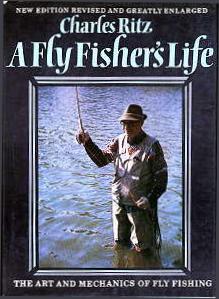
A Fly Fisher's Life (1959)
By Charles Ritz
Our sincere thanks to Crown Publishing Company
September 28th, 1998
 Publishers note: Since this
publisher is older than dirt, it occured to me that some may never have
seen many of the older books. From time to time, we hope to
excerpt interesting segments from our personal library to enlighten,
entertain and perhaps amaze our rod building friends. Some things
are older than you might think. Most of these books are long out
of print, and if we spark an interest in you, check out the used
book stores, or one of the mail-order book sellers. Armchair Angler
in Hillburn, NY is one we particularly like. We previously
ran a series on bamboo from Ring of the Rise, (check the archives)
which I understand is now available in reprint. Your suggestions
and comments are always welcome.~DB
Publishers note: Since this
publisher is older than dirt, it occured to me that some may never have
seen many of the older books. From time to time, we hope to
excerpt interesting segments from our personal library to enlighten,
entertain and perhaps amaze our rod building friends. Some things
are older than you might think. Most of these books are long out
of print, and if we spark an interest in you, check out the used
book stores, or one of the mail-order book sellers. Armchair Angler
in Hillburn, NY is one we particularly like. We previously
ran a series on bamboo from Ring of the Rise, (check the archives)
which I understand is now available in reprint. Your suggestions
and comments are always welcome.~DB
The Split Cane Fly Rod, Part Four
(Excerpt from Part III: Research and Technique)
"My methods of trial and perfecting"
"Basic diagrams for the first prototypes.
Study of the prototypes on the diagram of curves (normal
minimum and maximum curve). The definitive establishment
of the proportions by a simple and rapid process which I have
called the longitudinal displacement of cones (this is a little
secret). Then the making of a new prototype and then two more
with slight variations increasing or diminishing either the tips or
the butts as the case may be.
Selective trials, eyes blindfolded, of these
prototypes in the hand, without a line, to get the feel of the
flexion.
Casting trials with a line, by Creusevaut,
while Plantet and I observe the curves and vibrations. Every
rod must permit a cast of twenty-seven yards.
Trials for slow and rapid cadence.
Trials for wave in the line.
Trials against the wind.
Trials for precision in placing the fly, fifty casts
at targets at fishing distances to see that the rod tip does not deviate
to right or left.
Trials for speed at targets. Fifty chronometric casts.
Each prototype has its own trial report, and the study
of these reports gives us very precise indications for the final perfecting.
Trials of prototypes on the river in conditions with
which we are familiar.
Each prototype is ready prepared with line, leader,
fly and sixteen yards of line employed on the water; then Creusevaut and
I try three rods immediately after the other so as not to lose the feel in hand
of the preceding one. This is very important. Use this method to select
your rod, also to compare lines. You will be amazed to find how
instructive and accurate it is.
After a definite choice has been made, the approved
prototype must then be used fishing for a whole season. It will be tried
out by a great number of anglers, good, bad and indifferent. When the
people we have lent it to want to go on fishing with it instead of handing
it back to us after a few minutes, we feel reasonably sure that we have
come to the end of our researches.
There are not dozens of types of action, but one
only, whose rigidity varies according to the length of the rod, and it
must work progressively from the point to the handle without the
slightest weakness, however used. The action may be more or less
powerful, but the successive curves must be identical. This is the
action which I have called 'Parabolic', though the term is only a figure
of speech, and the curve of the rod has absolutely nothing to do with
a parabola. This name used commercially dates from 1937. Since then,
we have been researching into methods of increasing the suppleness
still further without diminishing the strength. After many failures we
finally succeeded, in 1949, in achieving a series of six different models,
called Super Parabolic P.P.P. (Progressive Pendulate Power).
I have said that the rigidity or suppleness must
vary according to the length. Thus, the speed of a rod is in inverse
proportion to its length (short: rapid; long: slow).
Short rod: the line moves backward and forwards
nearer the ground. It needs to travel backwards and forwards more quickly to
avoid loss of speed which makes it touch the ground behind or become hooked
up.
Long rod: the line travels backward and forwards
on a higher level. Therefore loss of speed is less dangerious. The cast can
be slower, though this does not prevent its being fast if the caster's wrist
demands it.
A supply rod without weakness will respond better
to the wrist than a rigid rod which requires the whole arm to put it into
action." ~ Charles Ritz
Next time,"What I Demand Of A Good Fly Rod"
|