The Split Cane Fly Rod
(Excert from Part III: Research and Technique)
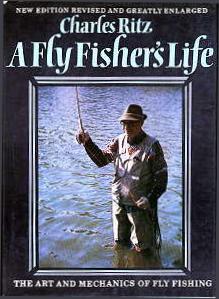
A Fly Fisher's Life (1959)
By Charles Ritz
Our sincere thanks to Crown Publishing Company
August 10th, 1998
 Publishers note: Since this
publisher is older than dirt, it occured to me that some may never have
seen many of the older books. From time to time, we hope to
excerpt interesting segments from our personal library to enlighten,
entertain and perhaps amaze our rod building friends. Some things
are older than you might think. Most of these books are long out
of print, and if we spark an interest in you, check out the used
book stores, or one of the mail-order book sellers. We previously
ran a series on bamboo from Ring of the Rise, (check the archives)
which I understand is now available in reprint. Your suggestions
and comments are always welcome.~DB
Publishers note: Since this
publisher is older than dirt, it occured to me that some may never have
seen many of the older books. From time to time, we hope to
excerpt interesting segments from our personal library to enlighten,
entertain and perhaps amaze our rod building friends. Some things
are older than you might think. Most of these books are long out
of print, and if we spark an interest in you, check out the used
book stores, or one of the mail-order book sellers. We previously
ran a series on bamboo from Ring of the Rise, (check the archives)
which I understand is now available in reprint. Your suggestions
and comments are always welcome.~DB
The Split Cane Fly Rod, Part Two
(Excerpt from Part III: Research and Technique)
"How to select a cane rod without allowing yourself to be unduly influenced."
"Before describing my methods of examining
rods, here are a few considerations I believe to be of importance.
Let us first rid ourselves of a widespread idea,
which I have often had occassion to point out as false or, at least, much
exaggerated: the reel does not balance the rod; though in the past when
rods were ten feet or more, very long and heavy, a reel as a counterweight
did produce the illusion of balancing the rod in the hand; but it is the line
which plays the principal role owing to its weight and the shape of its taper.
It is, indeed, on the line that the rod depends above all for giving its
maximum, and yet retaining its balance. The ideal would be to be able to
fish with the reel in your pocket.
Examining a rod in the shop enables you to
determine its quality, its approximate power and its type of action; but
actual casting on the water will alone show you whether it suits your
particular physical and nervous make-up; in a word, whether it will tire
you or not. For, indeed after a long day's fishing, you do not want to
feel, at the evening rise, that you are fishing with a broom handle. If
you still have full control of it, if your wrists can manipulate it as easily
as at the beginning of the day, you have a rod that suits you physically
and temperamentally. This is the first and most important point. I
must excuse myself for talking of Parabolic rods most of the time.
I must make it clear that I am not doing so for the purpose of
advertising these rods, but merely as a convenient reference and in
order to determine exactly the type of action. There are many first-
class rods by other makers which will give you full satisfaction.
The best advice I can give a beginner is to
choose a cane rod of one of the following types: Parabolic 8 1/2 ft.
normal, Ritz Parabolic 8 ft.2in., or Ritz Super-Parabolic P.P.P.,
Master 8 ft.2in. or Powerplus P.P.P., according to the amount of
money you have to spend. I only give these rods as examples; any
other make providing a similar action will be just as suitable.

Still talking generalities, I must point out that,
in a fly rod, even the shape of the handle is sometimes enough to tire the
fisherman and give him cramp. Long, cylindrical handles with the
minimum of curve and of a comparatively small diameter reduce fatigue,
the risk of cramp and the likelyhood of acquiring blisters to the minimum,
unless you have a large hand when the cork handle should be thicker.
I prefer extra light reel fittings (flange and ring), weight
being the enemy of precision.
I consider that a rod should have eleven to
thirteen rings according to its length. The ring at the point should be
very light, as should the bottom one. They should be in hard chromium-
plated metal. The agate ring belongs to ancient history. The intermediate
rings I prefer are those in snake form, of fine tempered steel, either
bronzed for chromiumed.
The ferrules, in rods of quality, need particular
attention. Only nickle-silver, bronzed or chromiumed outside, can
be considered. The portion of bamboo which enters the ferrules must
not fit too tightly as this may result in the breaking of the rod tip at the
joint. The male ferrule should be very slightly conical, in order to take
up the wear and tear which is inevitable in the long run. The first
condition of a good rod must fulfil is that the bamboo should be
guaranteed by its place of origin. The best is called Tonkin cane, such
as Palokona, from Hardy, or Pingona. Tonkin cane contains about
20 per cent water. Seasoning, essential before manufacture, and
tempering, should reduce the water content to 5 or 7 per cent. It is,
of course, almost impossible to eliminate the water altogether without
danger of carbonisation.
Correct tempering lies between the minimum condition
in which the bamboo is under-tempered and the maximum entailing
carbonisation of the fibers. There is, therefore, a golden mean that produces
a cane at once lithe, light and infrangible. The achieving of this precise
condition is a great secret that, naturally, I have no right to reveal!
While talking of wood, I must point out that some
bamboos are camouflaged with brown dye, the object being to give them
an appearance of having been tempered. It is not always very easy to
detect this abuse. Nevertheless, bamboo often displays a difference
in colour though subjected to the same tempering process. That is to say,
it may turn more or less dark though retaining similar qualities. If, therefore,
you find slight differences in colour on the various sections of bamboo on
the different facets of the same rod, you should not necessarily conclude
that this is a defect. Indeed, I would go so far as to say that it may well be
the opposite, for it is obvious that camouflage will be applied to every
facet equally to obtain a more generally attractive appearance.
The nodes should be at different levels in each section
of the rod, that is to say that they should not be opposite each other. The
most that is acceptable is that three strips out of the conventional six strips
have their nodes at the same level, but only on conditions that the strips
are on opposite sides of the rod.
The essential part of the rod, as I have already
said, is the top joint. If there are two, they must be identical, so that
they are interchangeable without altering the rod's action." ~Charles Ritz
Next time, When should you choose
a rod? and more. . .
|