Robert W. Summers
by Andrew L. McFarlane, Special from the Northern Michigan Journal
June 8th, 1998
Bob Summers waved me in to his home right on the Boardman River,
just south of Traverse City. He was on the phone with a customer who was apparently wondering if
a certain old rod would be a good investment. "Well," said Bob, "It might be a steal, I mean there's
chairs and tables that have sold for a quarter of a million dollars."
His implication was clear. While no one can predict the vagaries of any
market, no one ever caught a fish with a Louis XIV chair!
Robert W. Summers has been making split-cane bamboo rods since he was 16
years old. He started with the Paul H. Young Company in 1956 as an afterschool job. Under Paul Young,
one of the all-time great makers of cane rods, helearned the intricacies of an ages old craft. After 18
years and moving from the Detroit area to Traverse City with the company, Bob decided to strike off
on his own. While he admits that his own path has been none too easy, he has no regrets and has reached
the point where a cane rod from the R.W. Summers Company is among the finest in the world.
We went out to his shop, a building adjacent to the house which, like the
house, Bob built. The shop is rather large, but nearly every available inch filled with machines and
cane rods in various stages of completion, making it seem smaller than it really is. Once in the door,
Bob began to show his treasures: a lathe which he completely rebuilt, a bandsaw which, he admitted,
"Is probably more tool than I can really justify for what I do with it," and a whole lot of rod.
"I think that I get as much fun and satisfaction out of the tools and the equipment
and the methods as I do out making the rods--let's face it, there's no single way to do anything.
I'd probably have been working for one of the auto companies if I hadn't gotten in to this--I really love
making things," Bob confessed.
And make things he does. Every piece of an R.W. Summers rod, with the exception
of the wire guides which the line runs through, he machines, by hand, himself, right down his own rod cases
with their distinctive scalloped caps. Bob took me through the stages of making a rod, walking over to some
8 foot lengths of raw bamboo. "Tonkin cane, it only comes from one place on earth (the Guangning Province
of China) and since 1900 the Charles H. Demarest Company has been the major importer. It's almost like
a family thing between the importer and the Chinese family--they haven't traditionally been willing to deal
with anyone else." He rapped one cane with a knuckle. "It's hard, like iron.
From those initial columns, Bob shaves off long strips that are heat-treated over an
open flame, turning the bamboo from its green-brown natural color to a rich coffee color. There is a wide
range of colors in split-cane rods. Some take it only to a light blond, while others, like Bob, prefer it darker.
"The heat-treating hardens it." He ran his hand along the surface of a strip, "You see how there's a bump
at every node? You have to warm it up, straighten every one of those bumps out by pressing at the node.".
Once the cane has been straightened and treated, Bob then cuts the strips into 60
degree triangles and glues six of those triangle together, wrapping them tightly with thread, trying to get the
straightest and tightest rod possible. He sighted down a length with his practiced eye and bent slightly--a
straight rod is a must. The glue is then dried for a couple of days at around 90 degrees and thoroughly
cooled before removing the thread and carefully hand-filing to take off the glue. Bob demonstrated, taking
great care to not remove any of the outer "power fibers", completing the task with a minimum of swift, sure
strokes.
After a very fine steel wool rubbing and linseed oiling, the cane is truly a beauty to
hold and behold. It has a pleasing heft and balance which makes you want to take it right down to the
river. If one did not know that six pieces had been used to make one, their only clue would be the
distinctive star pattern on the butt of the rod. Bob said a bit about the alternative to bamboo in today's rod
market--graphite. "There's a lot of folk now who start out with graphite and when they move to cane, they
can have trouble. Graphite will take a lot of abuse that cane won't." He thought for a moment and then smiled.
"Still, cane is more durable in some ways. I've seen a lot of graphite rods that someone just dinged the tip
on a rock." He made a shattering gesture, "That won't happen with cane."
To be fair, Bob added, "Graphite has a faster line speed and a faster stroke--if you like
that sort of thing. I think that there's even some reflection on a person's lifestyle in rod choice. I've noticed
over the years that a person's personality has something to do with which kind of rod fits them best. There's
some folks who are always going, going, going and graphite seems to suit them. Others are more comfortable
with cane. They're more likely to take their time as they move down a river and I think that they notice more.
I like to say graphite's probably the best substitute for a fly rod that's come along in a long time," he
laughed. "I feel that they are the lucky ones who have learned to cast and wait for the cane."
From the raw shaft, there is still a lot of work before it becomes a rod. Every component
of the rod Bob machines with care. He offers three reel seat options, sliding rings, cap and ring on black walnut
or a screw-lock seat, threaded on black walnut with a nickle silver cap at the back. "I like to use American
woods--black walnut, maple, cherry. Lately, they all seem to come from right around here."
The ferrules are the metal pieces that are the joint of a rod. To make the male and the
female of a ferrule, six seperate pieces are sottered and finely polished to a fit that is snug without being
difficult to unjoin.
At a worktable in the room of his house where he does the finer work, Bob wrapped
a little bit with copper brown thread as I watched, bending a guide that he judged not perfect. "These guides
are the only piece I buy and you wouldn't believe how you have to fuss with them. It's more a cosmetic thing,
really--you want them to look straight. I always use this same color that matches the color of the rods--it's
sort of my signature."
Each rod then recieves numerous thin coats of varnish. Three or four coats on the
wraps alone and then three more upon the whole rod. Bob showed another R.W. Summers invention,
a homespun contraption that looked like a cross between a gun rack and a towel dispenser. A small
engine turned a cloth belt wrapped around numerous wooden wheels. There were fittings for eight lengths
of rod, and the device turned each slowly and evenly. "I made this so that the varnish won't puddle up.
Lots of guys have to always be turning the rods while they dry. I guess I get a lot kicks out of inventing
the gadgets that ease the process along"
In this room Bob has some of his own collected rods, either trade-ins from
customers or ones, like the one he chose to show me, a Pezon et Michel from Amboise, France, that
he has bought for himself. He had taken the measurements of the rod with a micrometer (rod-building,
with it's precise tapers, is an exacting pursuit) like a scientist who has discovered a new species of bug
who wishes to instantly record it. "I'm always casting other rods. I don't want to say that I've seen them
all, but in 40 years I have seen an awful lot of rods. When I get a new rod in my hands that looks nice
and feels nice, I have this immediate desire to put a line on it and take it out to the river and see what effect
those particular dimensions have on the action. This particular rod I was willing to buy sight unseen because
it's a fine company and the same sort of semi-parabolic action as mine. I always anxious to see how it
compares with my own design. Every rod is a just a little different."
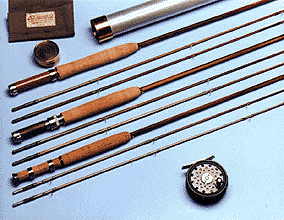
Finally his wife Evie sews a bag for the rod which is then packed into the tube. While Bob
fielded a call from a customer, I had another look at various rods, all in their cases in the custom rack
that he has designed. Some of the rods were used--if you're looking for a used cane rod, Bob would
certainly be a good fellow to talk with as he seems to have taken quite a number in trade over the years
and has a complete list of them. Others were his own. Idly, I fiddled with an R.W. Summers rod case
with my thumb. Smoothly, with virtually no effort, I was able to loosen and tighten the cap with only light
pressure from my thumb. I realized fully then what others have probably known for years. Robert W.
Summers is a man to whom details matter. A scalloped cap that is friendly to the human hand may seem
like a small thing. But dunk that hand in a river, chill it to the bone on a cold spring morning and grease it
with the holding of a fish, and that small thing probably seems a bit larger. It is those small things, when
taken together, add up to one of the finest rods, and rod makers, anywhere.
R.W. Summers Co. can be reached at 616-946-7923
Our thanks to
The Northern Michigan Journal for use permission!
|