|
In reading the FAOL bulletin board, I notice
there is often interest in bamboo rods.
This always pleases me. It's good to know that
other folks besides myself are fond of, or at
least curious about, cane rods. Over the past
year, I've reduced my graphite collection down
to two rods, and increased my cane collection up
to five. This has been part of a conscious effort
to move away from graphite and into cane. The two
plastic rods I have left, a 5/6-wt and an 8-wt,
are backup rods, in case I need to loan one to
somebody, or if I'm going to be fishing some place
especially treacherous.
There are many fantastic modern cane rod makers
out there. It's been said, and it is likely true,
that today's bamboo rods are superior to those of
the "golden age" in most ways. Yet these rods cost
anywhere from $600 and up, beyond the means of many
of us. Ebay lurkers such as myself can sometimes
find great deals on classic cane, but there has been
a surge of interest - and bidding! - on bamboo over
the last year or so.
My solution might work for others: Cane revival.
I've never built a graphite rod. But I've learned a
lot about cane revival. It's rewarding, it's fun,
and it results in a fishable, satisfying rod that
won't break the bank, and won't hurt my heart as
bad if something happens to it.
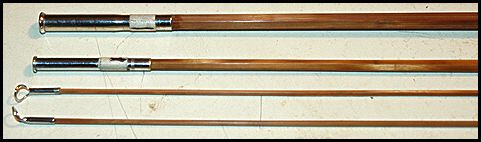
My last project was a Montague at seven-foot
ten-inches, a thee-piece, two-tip rod that I like
with a five-weight line. I got it from Mike Longuil
stripped, straightened, ferrules reset, with decent
cork and reel seat. The tip tops were already on,
all I had to do was get guides and wrap it, then
apply the finish of my choice. I ended up with a
great little rod for about $100.

Now, most of us who piddle with cane know a Montague
was a mid-grade rod, and among its offerings were
models both low-end and high-end. I don't know what
model this little rod was originally, but it has a
swelled butt and casts well, so I suspect it was
medium or high grade. The point is, I'm not expecting
to find and rebuild Orvis, Granger or Leonard rods,
nor do I want to. I want a fishable, enjoyable cane
rod that I can use and not fret over.
Of course, there's more to it than that. You probably
already suspected that, if you've read
Native Waters
any length of time at all.
It means something to me to take an old rod and
bring it back to life. A friend of mine's father
owned a sporting goods store here in town. My
friend recalled that when the demise of cane rods
came at the onslaught of fiberglass, his father
hauled many dozens of brand-new bamboo rods from
the shelves and threw them away, eating his cost
because nobody wanted them anymore. Breaks the heart.
But while I dream about coming across a Granger
with the shrink wrap still on the cork, the tube
unopened since sealed at the factory, reviving
used rods rings with more satisfaction. The little
Monty, for example. Someone fished it, somewhere.
Perhaps on the Battenkill, or some nameless creek
in Maine. Sometimes I let my mind imagine that
Harry Middleton might have fished one of my
previously-owned cane rods, though I know it's
practically impossible. Doesn't really matter.
Someone, somewhere, held that rod in their hands
and felt the same thrill of a fish on, the same
satisfaction of a good cast, the same admiration
for the fit and finish.
A good bamboo fly rod is like a good wooden boat:
It dies if it is ignored. Like an old house, where
the doors must be opened and closed, the floors
walked on, the windows raised and lowered. Nothing
causes a house to die more readily than being unlived
in. Bamboo rods are the same way. They must feel
the bend of a tip, the flex of line shooting through
guides. Otherwise, they're only so much wood. They
cannot be neglected. If so, they wither and pass
utterly.
Imagine the attachment some of us have to our
rods, no matter the material. Someone else
probably felt that way about the little Monty
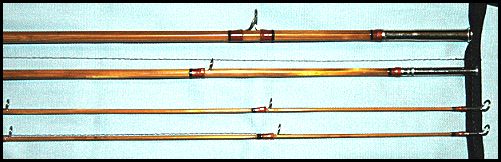
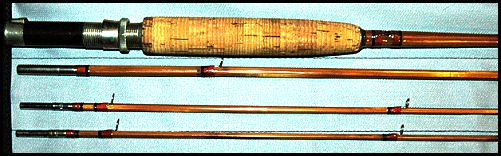
I just rebuilt. It's got a satin luster with
new varnish, red wraps with black tipping
securing new single-foot guides. The label
was long since gone, so I marked it, "7'10" #4/5,
REStouff '05, Montague." This was done not only
for my own records, but just in case some day,
some other angler holds that rod in his hand
he'll know what I do not: Who held it before,
when they held it, and that they thought
enough of it to keep it from dying, ignored.
Flakes of their skin, oils, are still in the
cork. A part of them stands at the edge of
the water with me. Nameless, faceless, probably
gone from this earth by now, but in a way,
still a part of an old bamboo fly rod.
Yes, perhaps I'm too sentimental. I probably
try too hard to glean resonance from things
old, attempt too vigorously to glean some
glimpse of its history. But now and then I
build a piece of furniture in my woodshop,
and I wonder where it will go, how many homes
it will stand watch in, if it will decades
from now end up in a landfill or still be
valued by someone. I worry who will care for
my father's wooden bateau when I am gone, who
will care enough for it to tend to its needs,
fret over it, fuss and nit-pick over it.
If you're interested in cane, maybe try a
revival. Like a good ol' fashioned travelling
salvation show. A little research to discern
the dud rods from the acceptable is all it
takes to pick up a piece of classic cane
suffering from being ignored. Chances are,
with just a little money and a little effort,
you'll end up with a rod that's fun, satisfying
and meaningful. And as a bonus, you might just
also feel some resonances. Some hint of
appreciation from the past. ~ Roger Stouff
|