|
"...Yes, a 9 and 8 weight cane, and can I have salt with that?"
Several months back I got a call from my good
friend and neighbor Jim. "Hey, I met this guy
who is really interested in your cane rods." Jim
had mentioned me to an associate at the local
diner after hearing an interest in fly fishing
during conversation. The gentleman was eager to
see my work and possibly would order some rods -
yes plural, 'rods'.
Soon after the initial introduction, we hooked up
at Martyn's Sea and Stream in Durham, NC. Martyn's
is the only surviving fly shop in the Triangle area
of NC and owned by my good friend John Martyn. Since
John has a casting range in the back of his shop and
is gracious enough to allow me access, it is the
natural place for me to take perspective clients for
a test drive. We started out with a fast action 7'
5/6 rod and then moved into a smoother, more
traditional action 8' 5 weight. I like to start this
way with the fastest taper I build since everybody
these days seems to be all about speed and distance...
but that's another story.
After a short test cast session and getting my
client to slow down and 'feel' the rod, he said
something all rod builders love to hear - 'okay,
I want to order three rods.' Wow, for a maker
that works his cane rods at night and weekends
with more love for the art than speed in mind,
this was a big deal. So, out came my order book
and my guidelines about deposits, etc... 'build
out a similar taper from the 5 weight into a solid
6 weight with the same flamed tones' okay so far,
'but what I really want you to start on is a 9 foot
9 weight for Little Tuny and a 9 foot 8 weight for
Bones that I can take to the Bahamas.' Okay, so how
would you have approached this? I remember I was
pretty quiet for a few minutes without writing
anything down. After a bit we began to discuss his
expectations about both the rods action as well as
their weight. To be honest, it was heartwarming to
hear someone that wanted to fish big cane rods again.
Everything today seems to be focused around the idea
that cane is not suitable for big rods; it's too heavy,
too slow, and not strong enough for big, fast fish.
So without going too far off subject, I will just
simply remind everyone that salt water fishing
didn't begin when we finally discovered fiberglass
and graphite. There was life before plastic. Anyway,
when I was convinced that he understood what the
final product would offer I accepted the order and
began to plan out the project. I like a good
challenge, and this project would test every skill
I had in my bag as well as my patience.
Now in case you are wondering the answer is 'No',
there are not very many published tapers available
for building a 9' 8 or 9 weight cane rod. I had to
begin by finding a vintage taper and working it into
something that met my expectations for handling
today's modern lines. But that's not all. When you
are designing a rod you must always go beyond line
weights and actions and remember 'how' the rod will
be used. Take the 9 weight and my client's description
of use - Little Tuny. These fish are caught from a
boat both near and off shore in depths of water from
10 feet to hundreds of feet. They are strong and
extremely fast.
In approaching the taper I had to build a rod that
would effectively cast a 9 weight line to schooling
fish, accurately deliver flies from ½" up to 6" long,
while retaining enough power to turn these little
rockets around or lift them from sounding under the
boat. In short, this rod had to have reserve power
in the casting stroke and plenty of backbone.
Now contrast the 8 weight. My client wanted a rod to
catch bonefish in the Bahamas and abroad. Most of his
fishing was done while wading shallow flats with rod
in hand. Bonefish are also quite different from Little
Tuny. Here is a fish that is very fast, can get fairly
large, but inhabits water that is sometimes as shallow
as 4 inches. Not much chance of a Bonefish 'sounding'
in a foot of water. These fish too are known for their
spooky nature. Small flies and delicate presentation
are often required. In designing this rod it was clear
I had a different set of guidelines. I needed a rod that
would allow delicate presentations, have enough backbone
to stop a speeding bullet, and be balanced in the angler's
hand while wading across the flats. (Notice I said balanced
and not light, there is a difference. Balance is more
important than outright weight - but that is another topic.)
It would have been quite easy for me to develop one
taper then add or subtract from the station measurements
to adjust for line size. Many rods are designed this way
and I will not judge them as good or bad. It's just not
the way I see things. For me, good rod design starts
with a vision of the angler in the environment that
holds their prey. An understanding of how the rod will
be used and the tasks it will face are the key. If I
had used the 9 weight taper and 'lightened' it for
the 8 weight line, it would have worked but would not
have been well suited for the conditions. Conversely
if I had used the 8 weight taper and 'weighted' it up
for the 9 weight line, it would have cast okay, but
likely would never stand up to the power and tactics
of the Little Tuny.
Okay, I knew what I had to build, and I had worked
up some tapers to build and test. So now, let's find
some suitable cane. There go another couple of weeks.
When you consider that the base section of a rod like
this can measure in excess of .400" and you want as
many large, tightly packed power fibers you can have,
not just any cane will do. I strongly believe in building
cane rods, 'that the end product is no better than the cane
that went into the project.' To me the equation is simple;
cane + taper + craftsmanship = rod quality. Sacrifice on
any one of them and the rod quality goes down.
Of course there is the rod hardware as well, but as
long as you use good hardware its all just window
dressing to me. You can put a top dollar reel seat
and guides on a mediocre rod and still have a mediocre
rod. You can also put a good quality (but not fancy)
reel seat and guides on an exceptional rod and still
have an exceptional tool. As one maker put it, "...I
can make it look any way you like." By the way, I
claim to be no 'master.' My rods are solid and I have
gotten good reviews but I give myself a B on craftsmanship.
There are always things I feel I can do better. When I
finish my 100th rod, I may ask one of the Pro's to look
and see if I can graduate.
Anyway, after calling around and buying some samples
of cane from a few different sources and comparing them
to my own stash, I had a reasonable selection of cane
to work with, so on with the build out. While there is
no need to go through every step of the process, I will
point out a couple of things. First, I temper all of my
rods, even the flamed ones. Flaming does drive out some
of the moisture and does assist in hardening the fibers,
but in itself is not true tempering. Tempering is
regulated heat applied over time to bound rod sections.
It has significant impact on the rod sections, not just
the cane. The result is a rod that is stronger, straighter
and lighter. Secondly, I pin all my ferrules. True, epoxy
glues of today are super strong and should last a lifetime.
But ask yourself if you have ever seen a pinned ferrule
come off of a vintage rod? Pinning is insurance. It's
there if you need it. To me its part of a good practice
method.
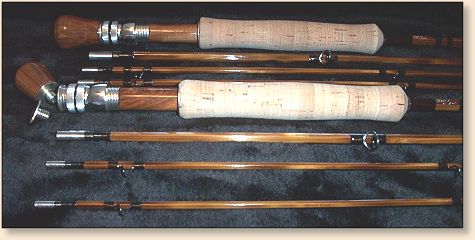
What you see in the picture is the end result of many
hours of time in planning and working up two very unique
rods. Both are 9 foot, 3 piece rods with matching
components, wraps, bags and tubes. Both appear ready
to meet the challenge of the task. However, both are
individual in character, focused on specific types of
fishing and prey.
Components:
Ferrules - CSE truncated Super Swiss, blued.
Guides - Hopkins and Holloway Titanium Carbide double foot snakes.
Tip Tops - Hopkins and Holloway oversized loop Titanium Carbide.
Strippers - Fuji Titanium Carbide.
Reel Seats and Fighting Butts - REC NS Anodized
Aluminum with Applewood inserts and Applewood
removable fighting butts (from the tree I grew
up with, thanks Mom.)
Finish - Absolute Coatings, Last-N-Last.
Silk - Java Brown tipped with Gun Metal Grey.
My client is now in the Bahamas doing what I should
be doing instead of working on rods - using them!
Since I haven't heard any bad news I'll assume he
is pleased and maybe the fish don't mind a little
of that 'old cane' around them either. All in all
this was a very challenging project that I thought
I would share. If for no other reason maybe someone
will look a little differently at that big heavy old
hunk of cane in the closet and remember there was
life with saltwater fish before we knew about plastic.
I may never build a set like this again, but then again
who knows. I can kind of see myself walking down a flat
one day with a cane rod in hand, well maybe.
*Note: I would like to take this opportunity
to thank some quality folks that have helped me along
the way over the past years. Without their help, advice
and kind words of support I would not have been able to
build these rods, and would have missed the endless hours
of enjoyment in the rod shop, the smiles on my kids faces
'helping me,' and the happy twinkle in a client's eye
when they get that new cane rod. Thanks to Jeff Wagner,
Dennis Aebersold, Ron Kusse, John Martyn and Charlie Ward.
P.S. - I won't hold you responsible for all the bamboo
splinters, cuts, burned fingers, spilled varnish, broken
thread, crooked nodes, etc.. ~ Buddy Davis
cdavis4@nc.rr.com (2weight), January 2004.
|