|
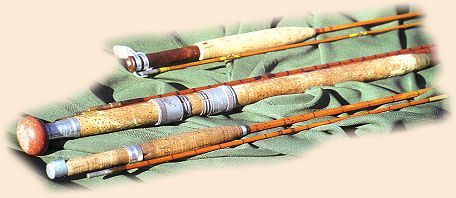
I receive an inquiry about an old cane rod
at least once a month. The rod is usually a
gift from an acquaintance or family member, or
was purchased at a flea market or other sale,
and the owner want to know what he has. The
questions are always: "What have I got?"; "Can,
or should I fish it?"; and the inevitable, "What's
it worth?" If the rod is a gift from a friend or
a relative's estate, it's sentimental value may
far outweigh its cash value.
Cash value is determined by the condition of the
rods, who made it, and which model. For example,
Payne rods are usually worth more than Leonard
rods, and short rods are worth more than longer
rods. A 7 foot Payne model is worth more than a
7 ½ foot Payne model. North American rods are
generally valued more highly than British rods,
although there are exceptions. Any Payne in poor
condition, such as short sections, missing guides,
or poor finish, loses much of its worth. If the
owner plans to fish the rod, some of these concerns
are not relevant. Short section lengths, replaced
guides, or a poor varnish finish may not affect
the rod's fishing performance.
Better split bamboo rods always have the maker's
name inscribed somewhere on the rod. Payne and
Leonard rods have their name engraved on the reel
seat metal work. Orvis, Heddon, and Hardy have an
inked inscription on the bamboo in front of the
cork grip. Some makers (Orvis or Hardy) also have
a serial number. Some of the low-end rods have a
decal on the rod shaft (such as Horrocks-Ibbotson,
Montague, and South Bend). A few makers also
identify the rods with a label on the rod bag.
Unfortunately, some of these identification marks
get destroyed or damaged with age or refinishing.
An experienced rod historian or rod renovator can
sometimes determine the rod's origin by other features
such as thread wraps or grip and reel seat styles.
The following list of rodmakers and their desirability
is arbitrary and based on my experience. I've probably
left a manufacturer out. In descending order: Garrison,
Payne, Leonard, Orvis, Granger, Heddon, Phillipson,
Shakespeare, Montague, Horrocks-Ibbotson, and South
Bend. In a recent E-bay auction, I saw a Garrison rod
with a reserve bid of $12,000 US. In Canada, we see a
lot of British rods. In my experience, the most common
are Hardy, Farlow, and Ogden Smith. Although there are
exceptions, British rods are generally viewed as softer,
more full-flexing rods than their American counterparts.
If you suspect that the rod has some historical
significance, or was made by one of the premium
makers, then the best thing to do is nothing until
you can find out more about the rod.
Collectable Rods
If you have decided that the rod is of sentimental
or historical significance to you, the best abvice
I can give you is do nothing to it. Simply put it
on display someplace where you will see it and enjoy
what it represents. Collectors and historians want
their rods 'as found', so that the methods of the
rodmaker are evident, without the alteration or
masking of later refinishing or restoration.

Restoration or Refinishing
There is a distinction between refinishing and
restoration. To refinish a rod is to bring it
back to fishable condition. No effort is made
to replicate the original methods or components
of the maker. Restoration is much more detailed.
The same silk thread and finishing method must be
used. Original snake guides or replicas must also
be used. If ferrules are replaced, they must be
accurate replicas. Every effort is made to restore
the rod to its original condition. For a high-end rod
such as a Payne or Leonard, restoration may be the best
choice. You should seek some advice on this. You don't
want to spend a $1000 on restoration if the end value
of the rod is less.
On the other hand, if you find an old Montague or
Heddon that needs a little work, then a refinish
will provide you with a relatively inexpensive
cane rod for fishing.
Purchasing a Rod for Refinishing
Let's say that you have your eye on an old split
cane rod. You want it to fish with but you haven't
made a commitment on it yet. Here are some point
to check.
First, what is the general condition of the rod?
Are there any obvious faults such as varnish
deterioration, damaged cork, or missing guides?
These can all be easily repaired. Delaminated
sections, fractures, and hook 'dings' can usually
be repaired, but get an opinion from a rod restorer
first.
Check the length of the rod sections to see if
they are all the same lengths. On North American
rod, 3 piece, 2 tips, every section should be the
same length. If they're not, it means there's been
a breakage and the section shortened in the repair
process. The most common breakage on bamboo rods
is just behind the ferrule or the tip guide. The
ferrule can usually be refitted to the rod, but
the result is a short section.
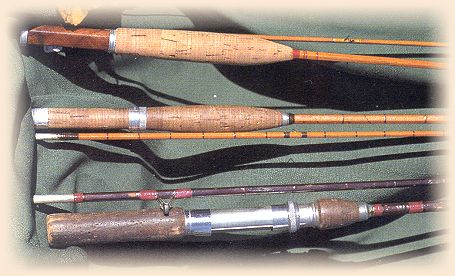
On the other hand, British rods were often made
with the bamboo sections of equal length, but when
the ferrules and tiptop guide were installed, each
section (butt, mid, and tips) could end up
different lengths.
The next step is to assemble the rod sections.
Sometimes the ferrules have oxidized and will not
fully engage. Modest cleaning with a mild abrasive
such as silver polish will usually clean them
up. If the ferrules are a loose fit, an application
of candle wax may tighten them up sufficient to get
a few more season's use from them. While the rod
is assembled, flex it and listen for loose ferrules.
You can hear a loose ferrule and feel it through the
rod. Some of the older rods were glued and pinned.
You can sense if the ferrule glue has failed and it's
just the pin that keeps it from coming loose. Loose
ferrules need to be removed and reglued. Sometimes
the only way to correct this condition is to remove
the existing ferrule and replace it with a replica.
This can be expensive.
While the rod is still assembled, sight down it to
see if there are any severe sets or bends in it.
All bamboo rods get sets if they are used much.
However, sets can be removed easily with moderate
application of heat and hand pressure. This is best
done by a rodmaker with some experience with this work.
While you are looking, check the condition of the
guides. If the guides are grooved with wear, they
should be replaced. Guides used on today's rods
are much larger to accommodate thicker modern fly
lines. Also check the thread wraps for deterioration.
The silk thread used on older rods tends to deteriorate
and fade with age. If rotted, it and the guide must
be replaced.
There seems to be an increase in interest in split
bamboo rods. Anglers are rediscovering the pleasures
and performance of a material that has been around for
over 100 years. In lengths up to 8 feet, bamboo rods
are forgiving and pleasant casting tools.
Reference:
Bamboo Rod Restoration Handbook, by Michael Sinclair.
The Fine Bamboo Fly Rod, A Master's Secrets of Restoration,
by Stuart Kirkfield. ~ TK
Credits: This article appears in the January/March 2004 issue
of The Canadian Fly Fisher. We appreciate re-print permission from
them and Ted Knott!
|