What's all the Hoopla about Cane Fly Rods?
By R.L. "Bob" Nunley, Rodmaker
Of late, there has been a lot of discussion about bamboo
fly rods, what they are, why people like them and how they
are made. Well, I've got my bulletproof vest on and ready
to make my opinion known, so fasten your seatbelts, and
get ready for the ride!
First off, there have been questions about what a good cane
fly rod actually is. Well, in my opinion, it's a finely tuned
casting machine that looks like a million dollars. A cane fly
rod, as I've mentioned in a previous article, is not only a
fine fishing instrument, but also a potential heirloom.
Now, what makes a fly rod an heirloom? Part of it is who makes
it! I mean, a rod made by Joe Rodmaker who nobody has ever heard
of may fish well and it may be a beauty, but that doesn't mean
it will be collectable someday. What makes collectability?
First, the maker has to pay his dues. By that, I don't mean he
has to work through years of apprenticeship or have been tutored
by one of the past or present day Masters of the craft. I mean
he has to commit his life to the making of a fine cane rod.
Much has been said about the heart of the rodmaker, but in my
opinion, heart has nothing to do with it. Relationships to cane
rods may be an affair of the heart, but the making of a fine cane
rod, while it may be a passion, has more to do with talent,
perseverance and commitment. I know there are very few rodmakers
out there who can just quit their "day job" and start making rods
for a living, and that's not what I'm talking about. I'm talking
about being committed to working into the wee hours of the morning
to make the perfect rod. I'm talking about not being able to accept
an uneven or gapped wrap. I'm talking about not being tolerant of
even the slightest flaw in the varnish. I'm talking about committing
your life to your craft.
These flaws, or lack of them, are what sets the trade rods, or
even inferior custom rods apart from a true custom fly rod. Many
of the production companies of the past, such as Montague,
Horrocks-Ibbotson, the companies that mass produced rods in
Occupied Japan after World War II, and a few others, did make
inferior rods, but not all of their rods were inferior. For
instance, Horrocks-Ibbotson had three very fine casting, very
finely outfitted two-piece rods, the Tonka King, Queen and Princess.
Montague, after acquiring the Thomas Chubb Rod Company in 1890,
continued to make Chubb rods in their Post Mills, Vermont factory
until 1932, and these were considered some of the finest rods of
their time. From time to time you'll even fine one of the Occupied
Japan rods that casts like a dream. Did these compete with the
better rods of the day, like the Leonard, Payne, and F.E. Thomas
rods?
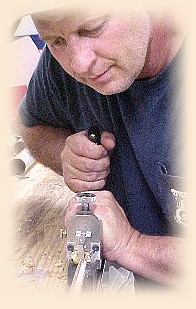 No, they couldn't compete with the Leonard's whose rods
were made on more 'finely tuned machines' than those "trade" rods
were. Oh, there's that word that has seemed to become an evil
uttering! MACHINE! That's right . . . Machines. Hiram Leonard,
to the best of my knowledge, introduced the first machine to
rodmaking in the 1870's. This machine was a beveller that would
produce perfect strips to make the perfect rod. Contrary to what
many believe, Hiram Leonard only hand planed for a few short
years before he saw the obvious advantage of using machinery
and there IS an advantage to using quality machinery. Think
about it! If handwork were really all that accurate, then the
makers of finely tuned racing engines would be using files and
hand reamers instead of surface grinders and lathes. As for the
old milling and beveling machines of the trade rod company's,
Thomas and Thomas still uses the old Montague machines, and
makes some of the finest rods in the world on them today!
No, they couldn't compete with the Leonard's whose rods
were made on more 'finely tuned machines' than those "trade" rods
were. Oh, there's that word that has seemed to become an evil
uttering! MACHINE! That's right . . . Machines. Hiram Leonard,
to the best of my knowledge, introduced the first machine to
rodmaking in the 1870's. This machine was a beveller that would
produce perfect strips to make the perfect rod. Contrary to what
many believe, Hiram Leonard only hand planed for a few short
years before he saw the obvious advantage of using machinery
and there IS an advantage to using quality machinery. Think
about it! If handwork were really all that accurate, then the
makers of finely tuned racing engines would be using files and
hand reamers instead of surface grinders and lathes. As for the
old milling and beveling machines of the trade rod company's,
Thomas and Thomas still uses the old Montague machines, and
makes some of the finest rods in the world on them today!
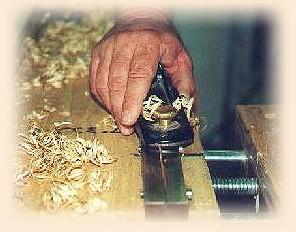
Please don't misunderstand; I have nothing against hand planing.
I hand planed well over 200 rods in my life. I've since moved
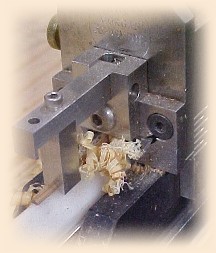
to a manually operated machine called the Morgan Hand Mill.
Why? Because it offers both ease of operation and more consistent
results. Even though I was very proud of my hand planed rods,
I quickly found I could produce a more consistent and better
quality blank with the Hand Mill than I could with a hand plane
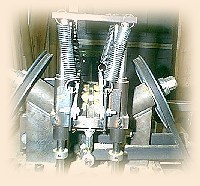
and a set of forms. Now, I'm making the move to a powered finish
beveller. Why, because, even though I'm proud of my hand milled
rods, I know the powered beveller will produce a more consistent
stick than either my planing forms or my hand mill. Sure, it
costs a lot of money to put something like that into operation.
If you started from scratch, a good bamboo miller or a good
beveller could cost thousands, even tens of thousands of dollars.
Spending that money is what part of the commitment is all about.
Putting your checkbook on the line to make better rods.
Now, I know up front I'm going to be challenged about hand
planing verses machining, but like I said, I've got on my
bulletproof vest, so fire away . . .but before you pull the trigger,
remember, the rods that the hand planers, even I when I was hand
planing, are doing their best to copy are Jim Payne's machine
built rods, Paul Young's machine built rods, The H.L. Leonard
Rod Company's machine built rods, H.L "Pinky" Gillum's machine
built rods, Thomas and Thomas's machine built rods, Winston's
machine built rods, and the list goes on and on and on… The
only maker I can think of that the majority of rodmakers who
hand plane will try to emulate the tapers of, is Everett Garrison.
Well, guys, I'm going to let you in on a little secret. In his
later years, Mr. Garrison's health was failing, and he was making
regular trips to the Leonard Rod Company's shop. When there, he
stated to an employee that if he were to ever try to go big with
his fly rods he would make a machine to make them. Yes, even the
man who all consider the ultimate hand planer, the one who most
in the craft consider the King of Rodmaking, dreamed of having
a power driven finish beveller. Mr. Garrison was a brilliant
man, and he knew and understood that the machines that turned
out such fine rods were "the way to go" if a man were to commit
himself to rodmaking as a living, rather than as a hobby.
Please, don't get up in arms too much! I'm not attacking hand
planing, I'm not attacking the Hand Mill (I will always keep
mine for doing my Quadrates) and I'm not attacking anyone who
will take the time and labor required to making a finely crafted
cane rod. All I'm saying is, just because someone wrote it in a
book, don't take it for granted that it is "THE" way to do it.
Hand planing is probably the best thing that ever happened to
hobbyists or low numbers production rodmakers, and I have a lot
of respect for hand planing. I've done a lot of it. I've done
a lot more of it than most rodmakers out there today. I've also
been a huge proponent of Tom Morgan's hand mill. It IS superior,
if one uses it properly, to hand planing. I'm also a big believer
in bamboo millers and bevellers. If used properly, they are
superior to hand planing and the Morgan Hand Mill, and in a
discussion on this subject, my friend Tom Morgan, former owner
of the R.L. Winston Rod Company (a company that has ALWAYS milled
their rods), and maker and marketer of the "Hand Mill," agreed.
He said that when he owned R.L. Winston that the machine they
used there, when properly tuned and adjusted, would turn out
perfect strips, with edges like razor blades.
Again, I don't want anyone to misunderstand, because I don't feel
there is a right way and a wrong way to make a rod. What I feel
is that there are easy ways and hard ways to make rods, and some
methods, by nature, are more precise than others. So, what do
I think about the different methods? In a nutshell, some hand
planed rods are great, some suck. Some hand-milled rods are
great and some suck. Some machined rods are great and some suck.
Not everyone can become a good rodmaker, not every rodmaker can
make a good rod, regardless of his methods or how many rods he's
made. You have to depend on a maker's reputation, his product
and his commitment. Know your maker; know more about bamboo
fly rods in general. Find a source for good bamboo fly rod
information and educate yourself. Find out what a good rod
is all about! Find out what a good rodmaker is all about!
Find out if that maker has made a commitment to his rodmaking
and to the quality, or if he's just trying to drag down a few
extra bucks turning out a few fishing poles. Bamboo fly rods
are expensive, so be sure you're making a good and wise
investment. Be sure your rodmaker has a commitment to the
craft that insures YOU are going to receive a quality rod.
Tom Morgan, in a telephone conversation that we had during
the writing of this article, told me that a rodmaker should
ask himself two questions . . . If this rod were being built
for you, would you want it? And if this were the only rod that
you made, that anyone would ever see, would you want everyone
to see it? If every rod turned out were put under the scrutiny
of those questions, there would be a lot less bamboo fly rods
floating around on the market today.
 As for Hand Planing vs. Hand Milling vs. Machine Milling, a
very good friend of mine recently wrote that planing forms
were the wave of the future for rodmaking and I'm sorry, my
friend, but I must respectfully disagree. Hand planes were
the predecessor of the Milling and Beveling machines. They
came first, and until the "book" about Everett Garrison came
out, they were considered to be the "old way" not the wave
of the future. As much as I was, and still am, proud of my
planed rods, I knew from the time I planed my first rod that
this was how it was done back in the 1800's, not the way it
would be done in the future. There are probably more bevellers
and bamboo mills running today than there ever have been in
the history of rodmaking and I would bet a nice shiny new 5
weight that in 10 years, there will be a lot more of them in
shops around the country. Sure, there are more hand planers
out there too, I can't help but think that after a hundred
or so rods, they will sit in their recliner after a long day
in the shop and daydream of that magical machine that would
allow them to more efficiently make better rods. Not make
them faster, not make them prettier, but make them better.
~ R.L. "Bob" Nunley, Rodmaker
As for Hand Planing vs. Hand Milling vs. Machine Milling, a
very good friend of mine recently wrote that planing forms
were the wave of the future for rodmaking and I'm sorry, my
friend, but I must respectfully disagree. Hand planes were
the predecessor of the Milling and Beveling machines. They
came first, and until the "book" about Everett Garrison came
out, they were considered to be the "old way" not the wave
of the future. As much as I was, and still am, proud of my
planed rods, I knew from the time I planed my first rod that
this was how it was done back in the 1800's, not the way it
would be done in the future. There are probably more bevellers
and bamboo mills running today than there ever have been in
the history of rodmaking and I would bet a nice shiny new 5
weight that in 10 years, there will be a lot more of them in
shops around the country. Sure, there are more hand planers
out there too, I can't help but think that after a hundred
or so rods, they will sit in their recliner after a long day
in the shop and daydream of that magical machine that would
allow them to more efficiently make better rods. Not make
them faster, not make them prettier, but make them better.
~ R.L. "Bob" Nunley, Rodmaker
About Bob:
Bob Nunley is a full-time cane rodmaker who lives in
Poteau, OK. You can visit his
website at: www.caneflyrod.com , or by email at:
caneman@clnk.com.
If you would like to comment on this or any other article please feel free to
post your views on the FAOL Bulletin Board!
|