A History of the Shakespeare Co.
Honor Built- Honor Sold
Eric Foster Jeska
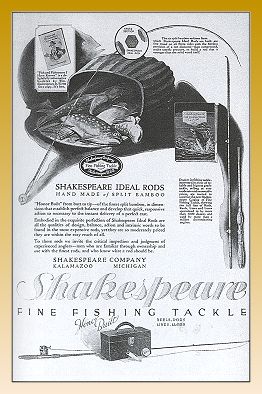 Few of today's anglers are aware that the Shakespeare Company
name and trademark were at one time associated with products
of the finest obtainable quality. While it is true that the
Shakespeare Company has always produced tackle with "Every man"
in mind, the company has also produced, at one time or another,
tackle of such high quality that it commanded the respect and
envy of the trade, and invoked a great sense of pride in the
tackle owner. The capability of the Shakespeare Company to
produce high quality tackle is obvious to anyone who has seen
the full-jeweled Deluxe "Professional" level winding reel,
with its hand-engraved fishing scene on its nickel-silver
alloy head and tail plates; or the beautiful "Miller Autocrat"
big game salt-water reel.
Few of today's anglers are aware that the Shakespeare Company
name and trademark were at one time associated with products
of the finest obtainable quality. While it is true that the
Shakespeare Company has always produced tackle with "Every man"
in mind, the company has also produced, at one time or another,
tackle of such high quality that it commanded the respect and
envy of the trade, and invoked a great sense of pride in the
tackle owner. The capability of the Shakespeare Company to
produce high quality tackle is obvious to anyone who has seen
the full-jeweled Deluxe "Professional" level winding reel,
with its hand-engraved fishing scene on its nickel-silver
alloy head and tail plates; or the beautiful "Miller Autocrat"
big game salt-water reel.
However, it must be remembered that the Shakespeare Company's
longevity was due in part to its ability to produce good affordable
products during America's many economic recessions and depressions,
which so often left men without work, but gave them plenty of time
to fish. Several of the other tackle manufacturers, who did not
enjoy such a broad base of support, and who emphasized high-end
tackle only, now belong to the distant past.
The Shakespeare Company founder, William Henry Shakespeare, Jr.,
was born on September 21st, 1869 in Kalamazoo Michigan, at a
time of seemingly endless economic depression which had
plagued America from the mid-1850's to the 1890's.
His father, William H. Shakespeare, was Michigan's youngest soldier
to fight in the Civil War, enlisting at the age of seventeen. Upon
hearing the news of the Confederate attack on Fort Sumter, the young
William Shakespeare was the first volunteer from Kalamazoo to step
forward and form Company K of the 2nd Michigan Infantry on April
12th, 1861.
He enlisted as a Corporal, and had obtained the rank of First Sergeant
by 1863 after fighting in such engagements as Blackburn's Forge, Bull
Run 1st, Bailey's Cross Roads, Munson's Hill, Fair Oaks, Yorktown,
White Oak Swamp, Malverns Hill, Bull Run 2nd, Chantilly, and
Fredericksburg. He was wounded by a bullet through both legs
at the hips, and by other bullets that struck him as he lay
wounded on the battlefield during an infantry charge on enemy
lines at Jackson Mississippi on July 11th, 1863. The young
Sergeant was not expected to survive, and was told by the
surgeon that he had only hours to live, and was awarded a
battlefield promotion to Brigadier General. He barely survived
the 33 day transfer from Mississippi through Confederate lines
to a General Hospital in Cincinnati, Ohio where he lay for
the next nine months recovering from his injuries.
Upon his discharge in the summer of 1864, he quickly re-settled
into civilian life in Kalamazoo, obtained a law degree and entered
into a law practice with his friend Nathanial Balch. He served
as Quartermaster General for the State of Michigan from 1883
to 1884. In 1896, he opened the Central Bank of William
Shakespeare, and continued to serve as an officer in the
G.A.R. (Grand Army of the Republic).
Such precociousness seems to have been a familial trait. One warm
spring morning, while on his way to school, the young Wm. Shakespeare,
Jr. came upon two men with a fishing rod and reel. The unusual manner
in which they manipulated the tackle caused him to pause and watch
with great interest and curiosity, being himself an enthusiastic
and competent angler. The man holding the rod had attached a small
weight to the end of the line, and after making his cast, attempted
to reel the line back onto the spool evenly with a rather crude
device which he had made for this purpose. The men were getting
frustrated when the invention wouldn't work, due to what Shakespeare
recognized as a fault of design and gross mechanical inaccuracies.
The inventor threw the rod and reel to the ground in anger and
declared that "It ain't possible to make one (level-wind reel)
that'll work."
"I think it is possible," the young Shakespeare answered, "and
someday I'll make one that will work." This remark was met with
laughter, and a red-faced William Shakespeare Jr. went on his way.
In 1888 at the age of 19, William Shakespeare Jr. resigned his
clerk's position at M. Israel and Company, a Kalamazoo dry goods
store, to work for George F. Green, the inventor of the electric
street car, electric dental drill, and pneumatic photo shutter.
Then in 1889, Shakespeare formed a partnership with Garrett W. Low,
and founded the Kalamazoo Shutter Company, building precision
behind-the-lens camera shutters. Shakespeare and Low received
several patents between 1890 and 1893 for photo shutters. It
was during this time that he began using his mechanical abilities
to create elegant casting reels for his friends. "Soon", he said,
"I had a great many friends". It was also during this period that
the principles for the level-wind mechanism were finally visualized
by the young man, as he sat on the edge of his bed pulling off his
sock. "It seems senseless, perhaps, to mention the sock," Shakespeare
later told in a newspaper interview, "but very likely men who call
themselves psychologists would say that it was important."
One can almost imagine the young man tracing a spiral pattern with
his finger across his Argyle sock, and creating a mental picture
of his idea.
Despite the economic hardships of the times, Shakespeare's business
flourished due to the high demand for camera shutters by the many
photographic studios which sprang up in small towns all across
America in an attempt to capitalize on the public's new fascination
with the modern techniques in photography which had rendered the
delicate and costly deurragotype, ambrotype, and tintypes obsolete.
With the even more promising outlook of new wide-spread economic
growth in the early 1890's, William Shakespeare Jr. became engaged
to his long-time sweetheart, Miss Cora Monroe, and the
two were married on November 10th of 1892.
For five years he devoted much of his spare time to designing and
crafting his level-winding reel concept into a physical reality.
Once perfected, Shakespeare filed for the patent rights for his
"fish-line reel" on May 13th, 1897 and was awarded patent #591,086
on October 5th, 1897 for his invention. He was now prepared, with
some financial assistance from his fathers' bank, to produce
for the angling world the first functional level-winding reel,
the "Style C."
This was not the first patent for a level-winding reel. Other
level-winding reels and devices had been patented now and then
for nearly forty years earlier by other inventors. It was, however,
the first functional level-winding mechanism to be issued a patent,
and this is an important distinction. A unique feature of this reel
was its use of two parallel carriage screws between which traveled a
looped line-guide on a block, instead of the single endless-thread
carriage screw which had been tried unsuccessfully by other reel
inventors. The earliest "Style C" reels have screws only on the
head plate, while later reels were improved with screws holding
the reel foot on both head and tail plates for added strength.
The Shakespeare Reel Works was first located in a four story storage
building on Water Street in Kalamazoo that had once housed the
Hanselman Candy Company. William Shakespeare Jr. had
rented this building since 1889 for his camera shutter business,
and together with Walter E. Marhoff and twelve other employees,
crafted his elegant handmade oxidized silver-plated reels on
the third floor using the same small jewelers lathes and watchmakers
tools that were used for making the photo shutters.
The first Shakespeare catalog, titled "The Fine Points of a Reel,"
featured only this reel, called simply The Shakespeare Reel, Style C.
Garrett Low died before the two partners received their final
photographic shutter patent in June of 1900, and Shakespeare
received another patent for a fishing rod handle that same month.
Shakespeare's young wife Cora died on January 15th of 1901 from
"consumption" or tuberculosis, a disease which was ravaging the
nation, leaving William Jr. as the single parent to his two young
children, Mildred and Monroe.
A few weeks later, on February 5th, Shakespeare received the patent
rights for a 'mechanical bait,' which he and Wm. Locher, a local
sporting goods retailer, had applied for in July of 1900. This
lure was marketed as the "Revolution" bait, and was basically
a pair of wooden floats with spinner blades and hooks attached.
Another more complex "Revolution" lure, which replaced the wooden
floats with watertight aluminum floats, was patented on April 9th,
1901.
A second reel design was submitted for patent on April 27th, 1901
and the patent for this non-level winding "Vom Hoff" style reel
was issued on November 12th. This elegant little reel was made
of jet black hard rubber with decoratively turned pillars and
handsome silver plated end plates. Like the "Style C," this
"Quadruple" reel featured a thumb controlled slide to engage
the click. And like the "Style C", it too was marked "Handmade."
Also in April of that same year, Shakespeare became a partner
in the Yonkerman Chemical Company, which soon occupied half of
his factory's third floor and produced the copper sulfate
consumption "remedy" called Tuberculozine.
It appears that he continued to build camera shutters as the
mainstay of his business, since the Kalamazoo city directory
for 1901 listed him as manager of Kalamazoo Shutter Company
at that same address, and his interests in the shutter company
were not sold to Garrett Low's widow until January 16th, 1902.
However, a greater interest toward fishing tackle was beginning
to emerge. Mr. Shakespeare knew of the differing needs of
fishermen and sought about to satisfy the varying tastes of
anglers who would buy practically any fishing tackle gizmo
if it were well made, and if it worked well he knew that they
would buy even more.
The 1902 Shakespeare catalog added three new reel models: The
Service, The Standard, and The Professional. These reels were
stated to be precision made to within one four-thousandth of
an inch from the finest German nickel silver and English Stubbs
steel, and ranged in price from $5.00 to $15.00, and this new
catalog also included bait casting rods, lures, and lines.
Mr. Shakespeare re-married on December 23rd, 1902 to his daughter's
school teacher, Miss Lhea West. In 1903, the Shakespeare catalog
introduced the Level Winding Reel "Style B" which was built of
nickel-plated hard-drawn brass and featured the newly patented
Shakespeare-Marhoff Harmonic Click and Graduated Drag which
helped to eliminate "backlash", or the tendency of the reel
spool to continue spinning from inertia after the lure had
slowed down, creating a terrible tangle in the line, as the
spool continues to unwind line that has nowhere to go.
The following year, Mr. Shakespeare added his new "Style A" Level
Wind reel to the 1904 catalog. This reel was essentially the
same as the "Style B" only made from German nickel silver by
Mr. Shakespeare himself, with a beautifully hand engraved
"Shakespeare" on the head plate. This reel was priced at
$35.00, which was, incidentally, the cost of a good horse
in those days.
Reel collectors are often puzzled as to why the Style "C" came
first before Style "B", then "A". It is the authors opinion that
there were probably two unsuccessful prototypes (A and B) prior
to the Style "C". Then, for marketing purposes, the later reels
were designated as "B" and later "A" to emphasize to the angling
public that the improvements were unique and substantial, and
worthy of the price increase. A close examination of the original
patent drawings clearly shows a very different reel design from
the reel which we know as "Style C."
Some have speculated that the original A & B reels were the non-level
wind reels that he made for his friends, but didn't patent. Obviously
Mr. Shakespeare knew the importance of patents through his other
enterprises, and I cannot believe that he would have neglected to
patent his own reels, nor infringe on another maker's patent by
reproducing similar reels for his friends.
Perhaps he named it "Style C" (a name which was already in use for
the largest capacity Yawman & Erbe automatic fly reel) in an attempt
to disguise the fact that his level wind reel would only hold 60
yards of line instead of the standard 100 yards that other non-level
wind reels of that size could hold.
Or maybe he named the "Style C" after his young bride Cora. At this
point we can only look back and speculate until documents are
discovered which reveal the true answer.
Mr. Shakespeare has been credited with the early use and advancement
of the short rod, which he felt would make the new sport of bait
casting easier for the novice to learn. The only rods listed in
the catalogs in those early years were bait casting rods, in nine
models, and all were 5-1/2 foot long.
Grade #1 was an all-wood two-piece rod with and ash butt and
lancewood tip. Grade #2 was a two-piece un-split bamboo rod.
Grade #3 was a three-piece lancewood rod with a spare tip.
Grades #4 through #9 were built of split-bamboo in a three-piece
design with an extra tip, and varied in grade with additions
of cork grips, closeness in the intervals of silk windings and
nickel-silver reel seats and ferrules. These rods ranged in price
from seventy-five cents to fifteen dollars, and like the early
Heddon rods, were built by the former Hiram Leonard Rod Company
apprentice, Fred D. Divine of Utica, New York.
Lures were the money-makers for the early business, and the company
was simply breaking even on the reels due to the amount of hand
craftsmanship necessary. The early lures were The Evolution (a
rubber minnow imitation), The Revolution, The Sure-Lure, The
Shakespeare-Worden Bucktail Spinner, and The Tournament Frog.
The profits from these immensely successful baits made it possible
for the Shakespeare Reel Works to move with its employees and
business into the old traction building of the Inter-urban
Railroad nearby on November 26th, 1904.
During the annual employee vacation on the last week in July of
1905, the entire plant was shut down so that machinery could be
overhauled, and during this down-time a new department was added
to the factory, a complete bamboo rod building shop, headed by
Mr. Thomas Perry of Redditch, England. Mr. Perry brought with
him over 30 years experience of rod-making skills to the Company.
On November 8th, 1905, the company incorporated, authorizing
$250,000.00 in stock, and changed its name to the Wm. Shakespeare
Jr. Company, adding $30,000.00 worth of automatic machinery.
Arthur L. Burrell was named Vice President, and Fred Green was
the Secretary.
It was during this period that Wm. Shakespeare Jr. bought the
Kalamazoo Fishing Tackle Company and its machinery from its owner,
Jay B. Rhodes, another local inventor who patented a mechanical
frog lure. Jay Rhodes also owned the patent rights for "The Rhodes'
Perfect Casting Minnow" which had been patented on December 13th,
1904 by his nephew Fred D. Rhodes, and which had been improved upon
by Jay with the addition of a clip hook-hanging hardware. Fred
Rhodes had operated his own lure and rod making and repairing
(and bicycle repairing) business from within his home on Bush
Street, and advertised his wooden minnow as "the best bait on earth."
Fred continued to make the lures for Shakespeare after his uncle Jay
sold the business, at least until Mr. Shakespeare became dissatisfied
with the poor quality workmanship that Fred was providing.
The Wm. Shakespeare Jr. Company was now into the wooden lure, rod,
and line manufacturing business, and Shakespeare's marketing expertise
soon made his wooden minnow lures one of the most popular baits among
sportsmen, and the most copied by his competitors. Carl J. Veley was
the employee who made the first Shakespeare wooden minnow. Another
local inventor, Bert O. Rhodes (Jay B. Rhodes older brother) assigned
his July 3rd, 1906 patent for yet another mechanical rubber frog
lure to Wm. Shakespeare Jr., and this lure also became a sensation
with bass anglers across the nation.
A Shakespeare employee, Walter Marhoff, developed his own design
of level-wind baitcasting reel, on which he was able to adapt and
perfect the single endless-thread carriage screw. A patent was
issued to the Marhoff Reel Company on October 23rd, 1906, and
his reels were improved in 1907 with the addition of a looped
wire line-guide, similar to the Shakespeare design, but with
a slotted shaft to support the top of the line-guide. These
reels were made in the Shakespeare factory under special
arrangement, similar to the manufacturing arrangements for
the private label reels that Shakespeare was making for the
South Bend Bait Company and others.
Marhoff died suddenly at his Forest Street home on the day before
his 39th birthday on October 25th, 1908, after having suffered
from a long illness with tuberculosis. His friends had seen him
working at the Shakespeare Reel Company and walking around town
only a few days earlier. In January of 1909 Wm. Shakespeare Jr.
filed for the dissolution of the Marhoff Reel Company, and took
over the business of his good friend, only two years after Marhoff
developed the reel that would become the level-wind design standard
for the entire tackle industry.
Mr. Shakespeare was deeply saddened by the loss of his good friend,
and paid tribute to Marhoff's inventive genius by placing the
"Marhoff Reel" in a position of prominence in the catalogs, its
design virtually unchanged throughout Shakespeare's life, and
by continuing to recognize him at service award banquets for decades.
By 1910, The Wm. Shakespeare Jr. Company employed 100 workers, and
had three full-time salesmen traveling the railways selling tackle
all across the nation to the far reaches of the still-wild West.
In 1913 a new factory was built at 417 North Pitcher street which
became the permanent Kalamazoo location.
In the early months of 1913 Mr. Shakespeare was in court defending
his Rhoades Wooden Minnow patent against the Enterprise Manufacturing
Company, a company in Akron, Ohio commonly known as Pflueger. Shakespeare
won the suit, and Pfleuger had to stop producing its "Wizzard Minnow"
and "Monarch Minnow" which had copied the hook hanger assembly patented
earlier by Rhodes.
The Wm. Shakespeare Jr. Company was now making 23 different bait
casting reel models; the "Uncle Sam," "Universal," "Criterion,"
"Precision," Service," Tournament," "Intrinsic," "Perfect,"
"Standard Professional," "Royal," "Expert," "Pilot," "Crown,"
"Triumph," "Crescent," "Vom Hoff's Patent," "Marquette," "Level
Wind B," "Level Wind A, " "Kalamazoo," "Ideal," "Marhoff," and
"Professional Level Wind".
On August 9th, 1913, Monroe Shakespeare (then 14 years old) was
involved in an accident in which he drove his fathers car into
the buggy of Dr. Wilbur. Fortunately, neither Monroe nor the
doctor were injured. Then only two days later, Monroe broke
his arm while cranking the automobile. These two incidences
led the Kalamazoo City Council to adopt an ordinance prohibiting
persons under the age of 18 from driving a car.
On September 2, 1915 the official company name was changed to
The Shakespeare Company. In spite of the shortages of manpower
and metals during WWI (a war which was popularly known as
"The Big Fuss") from 1914 to 1918, the company continued to make
its fishing tackle, and volunteered to manufacture trench mortar
fuses under a government sub-contract.
Three single-action trout reels were available in the early 1920's,
The Winner, The Featherweight, and The Kazoo. All three were
Shakespeare's versions of the earlier Meisselbach reels, simplified
for mass production methods. The same was true for the Russell single
action fly reel which was introduced in 1926. It was designed by
Shakespeare's chief reel designer and engineer Samuel Guy Russell,
who had previously patented the new method of riveting the reel foot
in 1920, although many features of the Russell reel were taken from
Mr. Shakespeare's personal "St. George" reel made by the famous Hardy
Brothers in England, which was purchased as the model for the purpose
of duplicating. The Shakespeare Automatic fly reels were introduced
in 1922, and were made in three line capacity sizes.
It was around this same time that Mr. Shakespeare and four other
Kalamazoo sportsmen, Dr. Rudolph Gilkey, Dr. Ralph Balch, Attorney
George McClelland, and Dr. Augustus Warren Crane (the internationally
famous X-Ray pioneer) purchased a hotel in Northern Michigan. This
spot on the Manistee River was known as Jam #1 during the logging
days only a few decades earlier, and now served as their "up north"
trout fishing retreat. This old hotel, along with a vast tract of
logged-over, and burned-over land in Michigan's northern Lower
Peninsula became the Sharon Properties Association, otherwise known
to the members as the "Knockers Club." A report of the annual meeting
held on November 31st, 1924 under the Jam 1 Bridge on the Manistee,
contained the following motion:
"Moved by Brother Dryflysky that Wm. Shakespeare, Jr. be assessed
four automatic reels for not showing up during the season of 1924."
The motion carried unanimously. Another report, dated June 2nd 1926,
discussing cabin repairs and improvement costs, states:
"Shakespeare seems to have a little of the best of the
improvements but he has promised to keep all members in tackle
for the rest of their natural lives, so we can afford to waive
our claim against him."
Later, Dr. Balch penned this letter to his old friend:
". . .As I look back it seems to me that the happiest hours that I have spent have been
with your products in my hand. Many of the hours were with you beside
me in the boat or near by on the stream, and so there was added pleasure.
We can remember sail fish as they burst from the gulf stream and walked
on their tails as they tried to throw the hook. The bright sun, the
blue water with the white foam flying. We can think of the flashing
strike of the blue fish in the surf or the heavy tug of the channel bass.
But I think more often our thoughts will turn to the waters of the
Manistee and the light rod bending with the surge of a rainbow or
the sharp smash of the brookie. So old friend, 'Here is to the
days that have gone and a double draft to the days to come. Be
they few or many may they be spent with a rod in our hands and
peace in our souls.
Fraternally,
Ralph
Around 1920, Mr. Shakespeare bought three bamboo fly rods which were
the finest available American rods of the times and sought to combine
the best features of each of these rods into one rod, a composite,
to become Shakespeare's best bamboo fly rod. These fly rods were
made in a three piece design with serrated and blued nickel-silver
ferrules, an agate stripping guide, and a polished aluminum and
walnut reel seat. The rod featured a swell of the bamboo above
the grip, and the delicate gold silk windings tipped in black
graced the guides, intermediates, and cluster wraps found at
the swell of the butt section.
Mr. Shakespeare's son, Henry, remembered that as a boy, he was
able to persuade the Shakespeare rod makers to build a lancewood
bow complete with split-bamboo arrows, for his own use.
Henrys' early recollections also include wandering through the
Shakespeare fly tying room, watching skilled hands tie the beautiful
Montreals, Scarlet Ibis', and other wet flies. Although the
"Iroquois Double Divided Wing" dry flies were imported from
England, the "Chippewa" bass flies, "St. Joe River" bass flies,
"Shakespeare Hoppers," and "Spring Brook" wet flies were all
tied in Kalamazoo. Later, all flies were supplied by Glen L.
Evans, Inc. of Caldwell, Idaho, and the Weber Lifelike Fly
Company of Stevens Point Wisconsin.
Bamboo rod production at the Shakespeare Factory ceased in the
early 1930's due to the heavy pressures of the failing economy
on what had always been a money-losing venture for the
Company.
The "Great Depression" nearly bankrupted the company by 1932.
Mr. Shakespeare met with the employees to let them know that
if the situation got much worse, wages would have to be cut. He
promised that the salaries of all management and executives,
including his own, would be cut before the wages of any employees.
Mr. Shakespeare went to Chicago, and then to New York in an
unsuccessful attempt to secure loans from the major banks in
order to continue operations. Emergency loan arrangements were
finally made when he found empathetic bankers in, as he referred
to it, the "city of brotherly love," Philadelphia.
Arrangements were made for Horrocks-Ibbotson of Utica New York
(formerly the Fred Divine Rod Company) to once again manufacture
the bamboo rods under the Shakespeare name. Later, bamboo rods
were made by South Bend Company in Indiana, Montague Rod Company
of and the Heddon Company of Dowagiac Michigan.
The Shakespeare Company held a long termed relationship with
Horrocks-Ibbotson Co., and its predecessor the Clark-Horrocks Co.,
as competitor, supplier, and customer. A letter from Edward D.
Ibbotson dated May 16, 1947 states:
"Well do I remember the first day I met you when you came to
Utica to see our concern. Then a few months latter I climbed up
the stairs in the old building and wandered around in various rooms
and finally found you hard at work developing a new level wind reel."
Although Mr. Shakespeare was ever vigilant to protect his patents
from unauthorized usage, he was at the same time very willing to help
his competitors when they needed his advice or assistance, and he
was called upon to assist these fledgling tackle companies often.
In a letter dated May 27, 1947 to Mr. Shakespeare, Mr. Ivar Hennings
of the South Bend Bait Company wrote:
"Very clearly do I recall visiting you at Kalamazoo along about
1912, and how graciously you agreed to again start manufacturing reels
for us and did so speedily to help us out. Also well do I
recall a meeting in Cleveland a few years later when you
informed the so-called, in those days, prominent fishing
tackle manufacturers that our company was or would become
a factor in this field."
When W. F. Eger of Barlow Florida dreamed up the idea of his now
famous Eger Dillinger bait in 1935, he could not find a supplier
for the spinners, hooks, eyelets, and screw eyes. No manufacturer
would furnish the small quantities that he needed. Mr. Shakespeare
told his Sales Manager to sell Mr. Eger anything he needed. Marathon
Bait Company of Wausau Wisconsin was in its infancy in 1932 when
it needed and received "helpful and sage advice" from him, and
Louis J. Eppinger (of Dardevel fame) felt that Mr. Shakespeare's
assistance was essential to the success of his business.
Employees of the Company received frequent visits in the factory
from Mr. Shakespeare, and he knew them all by name, as well as
the names of their wives, husbands and children.
Shakespeare Products Company was formed in 1921 and was made up
from the Kalamazoo Fibre Broom Company and The LoVis Company,
which manufactured can openers and parts for the "Roamer"
automobile. This was not Shakespeare's first attempt to diversify.
In the past twenty years he had been a partner in two patent
medicine companies, the Prof. Stephen G. Burridge Co. LTD and
the Yonkerman Consumption Remedy Company, manufacturer of the
tonic 'Tuberculozyne'. In 1911 he had developed and patented
a gasoline carburetor, and among his other personal involvements
were a roller rink and movie theater (The Kalamazoo Amusement
Palace), and a corset manufacturing company, the Kalamazoo
Corset Company.
The trade name of the "Kalamazoo Tackle Company" was reinstated
by the Shakespeare Company in 1935 for the purpose of manufacturing
a line of less expensive bait casting and flyfishing reels, allowing
Shakespeare to sell directly to dealers, eliminating the "jobbers"
or distributors and keeping the costs and prices down where they
could compete with the other discount brands on the market. This
new division added 20,000 feet of factory space and was supervised
by Monroe.
In 1939 the Shakespeare Company introduced Mr. Shakespeare's latest
reel concept and design, the "Wondereel", which incorporate several
new features including an automatic compensating adjustment cap on
the spool end bearings, and improved drag mechanism.
During the Second World War the skilled Shakespeare craftsmen worked
around the clock on National Defence Work, and used their precision
machines to make the Norden bomb sights, the Sperry .50 caliber automatic
computing sights, self-locking irreversible quadrants for naval planes,
and flexible controls for tanks. The company was awarded three of
the prestigious Army/Navy "E" awards for excellence along with
a Silver Star for its role in helping the war effort. Post war
production resumed the manufacture of the choke controls for
carburetors at the Products Company.
In 1944, Dr. Arthur M. Howald, Technical Director for the Plaskon
Division of Libbey-Owens-Ford Glass Company, was on a trout
fishing trip in northern Michigan when he broke the tip of his
pet bamboo rod. Because replacement tips were impossible to
obtain during the war, he used his knowledge of glass fibre/Plaskon
resin fabrication to attempt a replacement tip of fiberglass.
Although it proved to be satisfactory, he continued to experiment
with rods made entirely of fiberglass. Dissatisfied with these
results, he revealed his experiments to Mr. Shakespeare's son,
Henry Shakespeare, the Company's new Vice President and General Manager.
Dr. Howald asked Henry what the ideal rod should cast like, and
Henry told him that no one had yet made an ideal rod, since each
fisherman and each fishing situation would require a different rod
action in order to be considered "ideal". Dr. Howald then wanted
to meet with the foremost authorities on fly rod casting and rod
design. He met with Paul H. Young, the famous bamboo rod maker
from Detroit, on the North Branch of the Au Sable river, and
later with Henry's friend Charles Ritz of France. Howald returned
from these meetings with the impression that there was room for
two more flyrod authorities, namely Henry and himself.
Patent rights were secured to produce the world's first fiberglass
fishing rod, the "Howald Glastik Wonderod," and Henry put the
Shakespeare Company back into the rod making business.
At the Tackle Manufacturer Association meeting that year, the
president of the Montague Rod Company asked Henry if he was not
making a big mistake in thinking that the American angler would
abandon split-bamboo for a fiberglass rod costing nearly sixty
dollars, and speculated that perhaps they might sell fifteen
or twenty rods in the first year. "We already have orders for
that many thousand!" Henry replied.
The first "Wonderod" test rods were made as flyrods, made up
from natural gray colored fiberglass blanks and had bright nickel
silver ferrules. The first "Wonderods" to appear on the market in
1947 were bait-casting rods, since casting rod tapers were easily
designed, and fly-rod tapers were more complex. Flyrod Wonderods
were available to the public later that same year. These first
production "Wonderods" fly rods were model #1390, a 8-1/2 ft.
three piece weighing under five ounces, and model #1290 7'9" two
piece weighing three and one-half ounces. Both sported the now
familiar milky-white colored fiberglass shaft with the spiral
markings of the cellophane wrap, and featured a genuine agate
stripping guide, serrated nickel-silver ferrules finished in
black, and a ring hook keeper.
By 1949, there were two more fly rod Wonderods added to the product
line; Model #1288 7 foot Fly/Spin combination weighing four and one
half ounces , and model #1289 7'3" weighing 3.4 ounces.
For the purpose of product testing, and possibly a little bit
of publicity, the top section of a fiberglass Wonderod was attached
to the main door of the Kalamazoo offices, so that the rod would
flex each time the door was opened.
Old Bill Shakespeare was justly proud of his new Wonderods, and
never passed up an opportunity to demonstrate his rods' ability
to withstand the strain of being flexed in a tip-to-butt arch.
During one such session of showmanship at the factory, the rod
fractured at the ferrule, and an embarrassed Mr. Shakespeare
marched down to the office of the plant manager with the
splintered rod in his clenched fist, and made his displeasure
known.
Bamboo rods took a back seat to the new fiberglass, and they were
practically hidden on the last page of the Shakespeare catalog.
The Company no longer purchased bamboo rods to sell, and the
ones which did appear in the catalogs were residual stock only.
The new Wonderod sold for $49.50, and the bamboo Triumph, Premier,
Au Sable and Spring Brook models sold for $15.00.
It was Henry who introduced the new "President" Direct-Drive bait-casting
reels, which were really more similar to the original "Style C" reel
first made over fifty years earlier by his father, than the later
quadruple geared reels that the "Style C" had evolved into.
In a "Swing to Spin" Henry introduced spinning tackle to the
Shakespeare line in the early '50s with his patented closed face
spinning reel, the Model 1810, which could be mounted below the
hand on a fly rod. His father was not as enthusiastic about spin
fishing, and had once commented on the new technique, saying
"Hell, that ain't fishin'."
The notion that William Shakespeare Jr. was a Communist may surprise
some, but was by no means a secret at the time. The national mood
after the Great Depression could have easily shifted to the
political extreme of Communism had it not been for the guidance
of President Franklin D. Roosevelt.
Mr. Shakespeare's corporate policies reflected his socialist beliefs
through his commitment to his employees' welfare, which was unknown
by the vast majority of corporate managers in those days.
He initiated the first credit union for his workers, and a profit
sharing plan that split the profits between shareholder and employee.
This resulted in a bonus of between $100 and $300 dollars per year
for each employee. During the depression years, he managed to provide
work for all his employees by reducing the hours that each worked.
He also provided Life and Medical Insurance for his workers. Mr.
Shakespeare was elected to the office of Mayor of Kalamazoo from
1933 to 1935, and was instrumental in the adoption of many public
policies, such as the Barter and Trade Commission, which allowed
an out-of-work man to maintain his dignity and provide for his
family by swapping services for goods.
After the end of the Second World War the Shakespeare Company entered
a new era of prosperity, largely due to the ability of the plant
to quickly resume the manufacture of fishing tackle, but mostly
to the developments of the new fiberglass rods and popularity of
past-time activity of spin fishing in general by the returning
soldiers, sailors, and airmen.
The new President of Shakespeare, Henry Shakespeare, lead the
Company during this prosperous era, allowing his father to spend
much of his time in Melbourne Florida fishing for sailfish and
tarpon, and hunting turkeys. Henry helped to oversee the purchase
of the Soo Valley Line Company in Estherville, Iowa. This
acquisition enabled the Shakespeare Company to manufacture
the new "Wexford" braided nylon fishing line, and fly lines.
In 1948 Mr. Shakespeare remarried for the third time to Mrs.
Alice Rebecca Jeska, herself a widow since 1925, and an acquaintance
whom he had known for more than 20 years through mutual friends.
He used this "retirement/ honeymoon" to start two new business
ventures, the Melbourne Broadcasting Company, and the Federal
Home Mortgage Association.
It was the turkey hunting that truly captured William Shakespeare
Jr.'s interests in his later years. Evening hours were spent sitting
in his favorite red leather chair testing his handmade cedar turkey
call boxes, and the house would be filled with the sounds of sandpaper
and 'squaaks'. His turkey call may have proved to be too good in
fact, for he was accidentally shot by one of his hunting partners,
and took several pellets in the leg.
The darkest chapter of the Company's history unfolded on September
7th of 1948, when the Steelworkers Union (CIO), of which only
30-40% of the employees belonged, declared a strike
against the Shakespeare Company. The Management didn't recognize
the Union as a representative of the majority, and the contract
with the Union was ended. All employees were invited back to work
on September 11th.
Picketers clashed with "scab" employees on October 11th at the
entrance gate, and several employees were injured. Then on December
1st a mob of 300 attacked the factory and wrecked the plant. Cars
and trucks were overturned and set ablaze. Windows throughout
the factory and office were smashed. Huge inventories of reel
parts were destroyed. Michigan's Governor Sigler was flown in
and the National Guardsmen were put on alert. On September 21st
of 1949 the courts ruled that the strike was illegal, and picketing
ended on October 10th.
Dismayed over the fact that so many of the employees had turned
against him, Mr. Shakespeare retreated to his winter home in
Melbourne, Florida, where he died a few months later on June 25th,
1950.
Henry moved the Soo Valley Line Company from Iowa to Columbia, S.C.
where the rod factory was already producing Wonderods and fiberglass
radio antennas.
The Shakespeare Push-button Wondercast Reel was introduced in 1957,
and the company was so certain that it would gain wide appeal to men,
women, and children that it launched a special advertising campaign
showing how easy it was to use. The revolutionary design for the
Wondercast was a collaboration between Henry Shakespeare and his t
op reel engineers Earl Clickner and Dale Harrington.
The first folding bail style spinning reel was added to the catalog
in 1959, and in that same year the Shakespeare Company acquired the
assets of Parabow Archery, Inc. of Waverly, Ohio, and began manufacturing
Shakespeare fiberglass and wood bows and other archery accessories.
By 1960, the Shakespeare Company was a leader in fiberglass development
in the United States and expanded into a variety of fiberglass product.
The reel manufacturing facility was moved from the Kalamazoo plant
to Fayetteville, Arkansas and began operations on January 1st, 1965.
At the same time, a new 1.5 million dollar factory was built in
Newberry, South Carolina which became Shakespeare Electronics and
Fiberglass. Later that same year the Noris Shakespeare Ltd. of
England was established on July 31st, through the acquisitions
of S. Allock & Co. Ltd. and J. W. Young & Sons, of Redditch.
Crawford Gordon was elected as the new President of the Shakespeare
Company, with Henry staying on as Chairman of the Board.
The next major expansion moves were the purchases of the Pflueger
Company of Akron, Ohio in 1966, and of the trolling motor manufacturer,
Phantom Products and the Plymouth Golf Ball Company in 1968. Also
at this time, Shakespeare opened a new warehouse facility in Orillia,
Ontario Canada. Winpull Fishing Accessories of Hong Kong now
manufactured baits and other terminal tackle for the Company,
and Stephen Trewhella succeeded Charles Crawford as the new
Company President.
Saddles and equestrians supply manufacturer Simco Leather Company
of Chattanooga, Tennessee , and Root Archery Company of Grand Rapids,
Michigan became the next acquisitions in 1969.
The Company's headquarters were moved from Kalamazoo to Columbia,
and an arrangement was made with the Omori Manufacturing Company,
a leading Japanese producer of fine quality reels, to build
Shakspeare's new spinning reels, and the new lightweight
"President II" bait casting and fly reels. The Shakespeare
research and development team was performing experiments with
graphite in the early 1970's when the material was first made
available to the industry. However, at that time, graphite sold
at $1,500.00 per pound. Henry Shakespeare was able to get his
hands on some of the new material at no cost from a friend in
the industry, and this provided them with enough graphite to
complete a few prototype rods.
In 1971, Mr. Trewhella made arrangements for Shakespeare to
market the skis of the Elan Ski Company of Yugoslavia across
the U.S. and Canada.
Simpson Electronics was acquired in 1974 for the production of
depthfinders, and by 1975, Shakespeare was producing its own
"Graphlite" fly rod as well as supplying the Orvis Company of
Manchester Vermont with graphite blanks for their own series of
graphite rods, during the short period in which Orvis converted
its fiberglass rod facility to graphite rod production. The
extremely popular fiberglass/graphite "Ugly Stik" made its
debut in 1976 and annual corporate sales quickly exceeded
the 100 million dollar mark, becoming the most popular line
of fishing rods that Shakespeare ever produced. Even the "CB"
radio craze had become a windfall for the company, as fiberglass
CB antennas exceeded the number of fiberglass fishing rods being made.
But by now, the "recession" had forced Shakespeare to discontinue
its archery and golfing lines, and many of the acquisitions that
were made over the past 20 years were also being discontinued.
In February 1980, Anthony Industries of California acquired a
majority of Shakespeare stock and voted these shares in a successful
takeover of the Shakespeare Company. Shortly after, Shakespeare's
President Stephen Trewhella and Vice president Ben Hardesty resigned,
and the new owners restructured the management, closing the Fayetteville
Arkansas reel plant and moving its operations to Columbia, S.C.
Early in 1994, the Shakespeare Electronics and Fiberglass Division
assembled a team consisting of plant personnel, marketing experts,
outside consultants, and the Southeast Manufacturing Technology Center
at the University of South Carolina, to begin a new product development
project using new approaches and technologies. With assistance from
the university, fishing rod design criteria could now be quantified
and computer simulated, rather than the old empirical methods of
design which relied heavily on trial-and-error methods to make
improvements. The results of this collaboration was the creation
of a new rod design, 15-20% lighter, yet stronger, with a reduction
in diameter of 25-30%. Shakespeare is once again regarded as an
innovator and market leader in fiberglass reinforced products.
Copyright 1997
Used with permission of Gabby Talkington, from
www.antiquelures.com
If you would like to comment on this or any other article please feel free to
post your views on the FAOL Bulletin Board!
|