I would like to make it quite clear from the outset, this article is based on the impressions
gained from a 12 day visit. Therefore the information, opinions etc. it contains, should be
treated as such, rather than an authoritative reference.
Recently whilst in Melbourne to see our new Grandson, also our first grandchild, I was
generously given a return flight to Darwin as a birthday present. This was in order that I
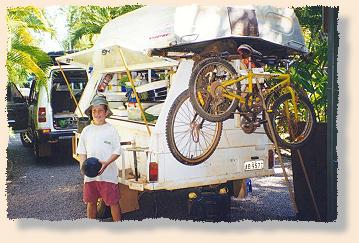
could link up with my younger brother Les, his wife Paula and their 9 year-old-son Jack
for a small part of their year long outback safari around Australia. They live in Cairns and
have been traveling in a 4wd. vehicle, towing a rugged outback camping trailer, with a 12 ft.
aluminium boat on top. I had previously enjoyed fishing with Les up the far Northern region of
Queensland, so was looking forward to a new experience in the Northern Territory.
Compared to fishing in New Zealand there appear to be some very noticeable differences
namely the heat, most days topped 40 degrees (Celcius) therefore adequate protection is
needed against the sun. Also protection against biting and nuisance insects is essential.
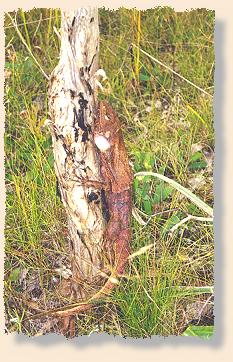
I am fortunate that normally, biting insects do not bother me too much, therefore
when warned about the sandflies at our first stop at Crabclaw, was not that concerned
until I noticed my arms and legs suddenly appeared as though I had contracted some
dreadful tropical disease. I was told these were sandfly bites, which was puzzling
to me, not having any sandflies about, certainly not as we know them anyway, pesty
things about 4mm long. It was then I discovered they are tiny there, about the size
of a grain of pepper but so much more vicious. I was told the reaction is not from
their bite but from their urinating on your skin. I still find this very hard to believe,
that the amount of urine such a tiny thing could produce, could have such an affect.
However if it is a fact, then it must be real powerful stuff, worth collecting maybe,
to produce super energy batteries or suchlike.
Mosquitoes particularly evening till daybreak, should be guarded against, although
it is near impossible not to be bitten, even with the best of precautions. Mosquitoes
can carry Dengue and Ross river fever as well as other tropical virus.
Possibly the best investment that can be made for only a few dollars, is a simple Asian-made
insect net, this hangs from a brimmed hat and deters the various flies that would otherwise
be relentlessly trying to get in your eyes, up your nose, on your lips, in your mouth or ears,
all at the same time. In fact buy two or three, you will easily triple your money reselling
them in the outback, to anyone unfortunate enough not to have purchased one.
I know - I did not have one!
The distances traveled to get from place to place, were tremendous from a Kiwi perspective
and often over very demanding terrain. Be warned also, the signposting is not always 100%,
confusing at best, other times misleading. Good maps are essential and checking whenever
possible, that you are traveling in the right direction is prudent, as often there is a long way
between gas stops. When after extensive traveling, you feel as though you have covered
most of the territory then you consult a full scale map, you realise you have barely scratched
the surface, so to speak, such is the size of the area.
Before we left Darwin I must confess I was getting a little impatient at the time taken
to buy provisions, thinking to myself “Why can’t we get these when we are underway?”
It was not too long before I became aware of the wisdom of doing so, as there often
as not, is simply nowhere to buy anything and if there is, selection is very basic, with far
from basic prices.
Probably the biggest difference with regard to fishing, is the fisherperson, in common
with his quarry, suddenly finds he is also potential prey, to crocodiles, sharks etc. This
is a new experience for most of us and sometimes it is easy to forget in the heat of the
day, as you drift along casting a fly sitting on the foredeck thinking how cooling it would
be to dangle your leg over the side in the water. Particular care must be taken when
releasing fish, none of the gentle Tongariro style (hold in the water to remove the fly)
otherwise you could find you have nothing to hold on with any longer. Fish to be
released should be held with a sack in the boat (unless you know the species to be
harmless, it could have nasty spikes or whatever) then slipped over the side to take
it’s chances. I found this became a natural reaction, but only after the first time I r
eleased a fish of about 3 or 4lbs. only to have the head, bleeding profusely, minus
the body, resurface on the other side of the boat moments later. I hesitate to tell this
true story that happened whilst I was there, however many of you may have read
of it in the papers already.
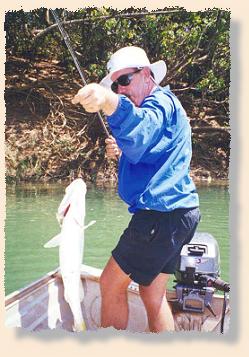
A guy was lost over the side of a charter fishing boat. A person on the same boat,
several days later caught a 1.6 meter cod and when about to clean it that evening,
noticed a lump in the gut area. He cut it open and out popped the head of the poor
guy lost previously. Presumably sharks had taken his body and the cod had picked
the remainder.
Most of the fishing, unless you have a larger boat to cope with the coastal conditions,
is done in estuarine type water, rivers or billabongs often a long way from the coast.
In my experience the fishing seemed to be a lot more variable than we are used to
in New Zealand and also to be far more affected by factors such as size of tides,
moon, times etc. Quite often it appeared a certain spot would produce fish after fish,
usually tarpon or similar, but on returning again same time next day, thinking you had
it all sussed, it would be quiet as.
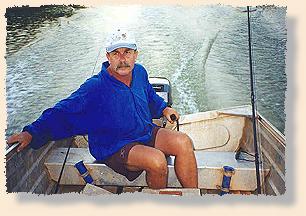
The tide rise is considerably greater than we are used to, therefore the tide flow should
always be considered when venturing out. If you go with the tide flow, often assisted by
river flow you can cover quite a distance quickly, but if you are against the tide coupled
with the river flow on the return trip, then it will take considerably longer and use a lot
more gas. Therefore the motor should always be of adequate horsepower to cope
with these conditions.
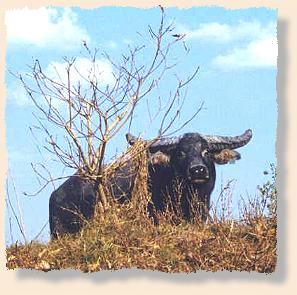
The weather depending on the time of year, will either be very hot, very hot and steamy
or hot and pouring with rain. If it is raining it is probably the wet season (summer) lasts
several months virtually nonstop and it is unlikely you will be going very far even if you
wanted to, as most areas will be in seasonal flood. This is when the fish , crocodiles
and so forth, tend to move about to various localities over what would otherwise be
dry land.
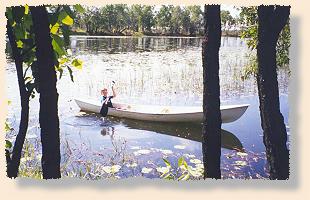
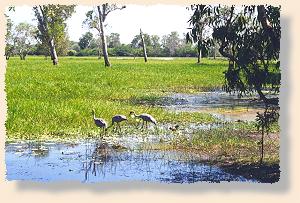
When the rain finally stops the water levels start to drop again, forming billabongs and
various waterways. I had previously always pictured billabongs as waterholes or ponds.
Whereas although usually longer than wide, often with a multitude of side inlets, they can
actually be quite large, similar to Lake Aniwhenua or bigger and need a boat to navigate.
It was in a billabong that we saw the largest croc, although only about 5mtrs plus (17ft.)
it gained great respect beside our 12ft. boat. These magnificent creatures I understand
can grow in excess of 7mtrs. (24 ft.) but their forebears were four times that size and
capable of dealing to many prehistoric creatures.
By and large the premium preferred target fish, seemed to be barramundi, we managed
to catch three in total, but remain convinced we could have increased the tally considerably
had we opted to live bait rather than flyfish. It is an interesting fish in as much as they can
be found in all sorts off different locations, offshore, estuaries, rivers and billabongs in both
salt as well as fresh water. Apparently most change sex at a certain age or size, to become
predominantly females, a bit like a lot of us fishermen that tend to turn into old women at
times, later in life. They can grow fairly big, although in common with most places, the
bigger fish are getting harder to find. They fight quite well and a relatively large proportion
of their size appears to be head. As to the often lauded eating qualities I find they have a
delightful texture but are a bit short on flavour compared to coldwater fish. Nevertheless
they are streets ahead of saratoga, a fish we were recommended to try, which with it’s
myriad of bones offered a gourmet experience similar to eating a fried brillo pad.
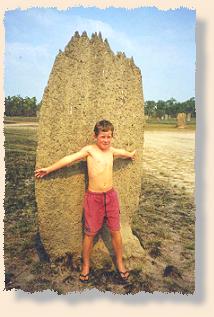
One thing in particular puzzled me somewhat about barramundi. In common with most
of the fish there the barras seemed to frequent the areas behind log build ups or suchlike
(the Aussies call them structures). Here they can prey on passing fish but still gain
cover should they suddenly find themselves on the menu of something larger. Therefore
they are usually fished for by casting a fly or lure, with as much landed disturbance as
possible, close to these structures. If a barra hits, it is usually almost immediately and
with his jaw making a loud snap, like a gin or claw trap going off.
The puzzling thing to me was, that when it is hooked, it invariably seems to run for
clear water, rather than the safety of the cover of snags, from where it would be
quite safe and impossible to land. Other fish like mangrove jack and suchlike do,
wonder why the barramundi have not woken up to something as obvious?
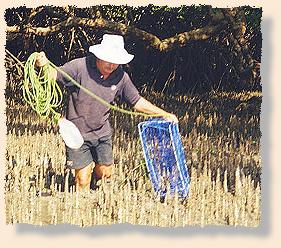
As well as fish there are mudcrabs and prawn type creatures to be caught, usually
in pots set overnight. These offer a delicious addition to the menu when freshly
cooked, accompanied by a chilled white wine. The mudcrabs are found in the
saltwater mangrove areas, are sometimes very large, with a rather fearsome set
of claws. Have been told a large one can remove a finger or toe. I do not know
if this is true, but did not want to find out when one (albeit smaller) got loose in the
boat, they move remarkably fast, but fortunately not as fast as a fear stricken Kiwi!
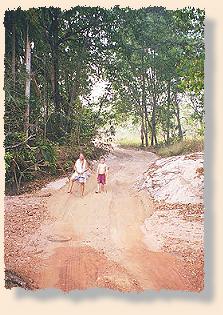
The prawn-like things were like long mini lobsters, with only one major claw, they
were to be found closer to where the salt water met the fresh and were called
something like (my spelling likely to be very suspect here) Cherobin. They seemed
to be reasonably prolific and were caught in pots set in water along the banks with
chicken pellets mixed with soap as bait, which seemed to work well enough. Was
only when we opted to use fish frames as bait we had most pots ripped open by
something or other, probably does not bear thinking about. When setting pots at
night a quick scan around soon establishes just how many crocs are present by
the number of red eyes reflected on the banks. These would be both freshwater
and saltwater crocs. The freshwater crocs I believe are only found in Australia,
are not quite as aggressive (Unlike their Olympic sports contestants ) as the
saltwater variety. Once again I stand corrected on this but the freshwater confine
themselves to freshwater or a mix of salt /fresh, are generally smaller with longer
snouts and eat mainly fish. The saltwater croc by comparison can be found in a
wide range of habitat, from offshore, to hundreds of miles inland, in freshwater
and almost anywhere in between.
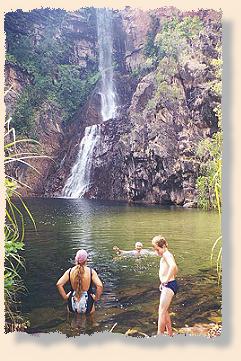
The National Parks (we visited Litchfield and Kakadu) offer magnificent scenery
and close natural encounters with wildlife, for a Kiwi too close for comfort, on
several occasions with snakes that is, as we do not have any snakes in New Zealand.
Waterfalls and swimming holes are a major attraction and a couple of them featured
in the movie “Crocodile Dundee.”
Significant area of the parks is prohibited access, due to having been mined for
uranium and of consequence now remains radioactive. It is interesting that the
Aboriginals have for centuries called these areas “sickness country” and had rules
that limited the time anyone could stay there, prohibited hunting or removing of
rock etc. Seems the white folk, thinking they knew better, rushed in, mined a
perceived valuable resource, which then dropped dramatically in value, are now
trying to contain the damage they unleashed.
To summarise, I am extremely grateful to have been afforded the opportunity of
an unique experience, particularly to those that made it possible. Les, Paula and
Jack by now will presumably have completed their trip through Arnhemland and
the Cobourg Peninsular. My grandson will have grown a little closer to when we
may be able to enjoy fishing together someday.
~ Barry Schultz
Originally published c. March 11, 2001 on Fly Anglers Online by Barry Schultz.